All 9 College Board units covered — podcast episodes, flashcards, essential terms, unit Cheat Sheets, and visual reviews for every key concept.
9 units covered
7 resource types per unit
College Board aligned
Free for all students
Each unit includes:🗺 Cheat Sheet⭐ The Essentials🎨 Visual Reviews🗂 Flashcards🎙 Podcast✍️ SAQ Practice📝 MC Practice
1
Unit 1
Period 1: Contact & Colonization (1491–1607)
1491–1607 · approx. 4–6% of exam
🎙
Unit 1: Period 1: Contact & Colonization (1491–1607)
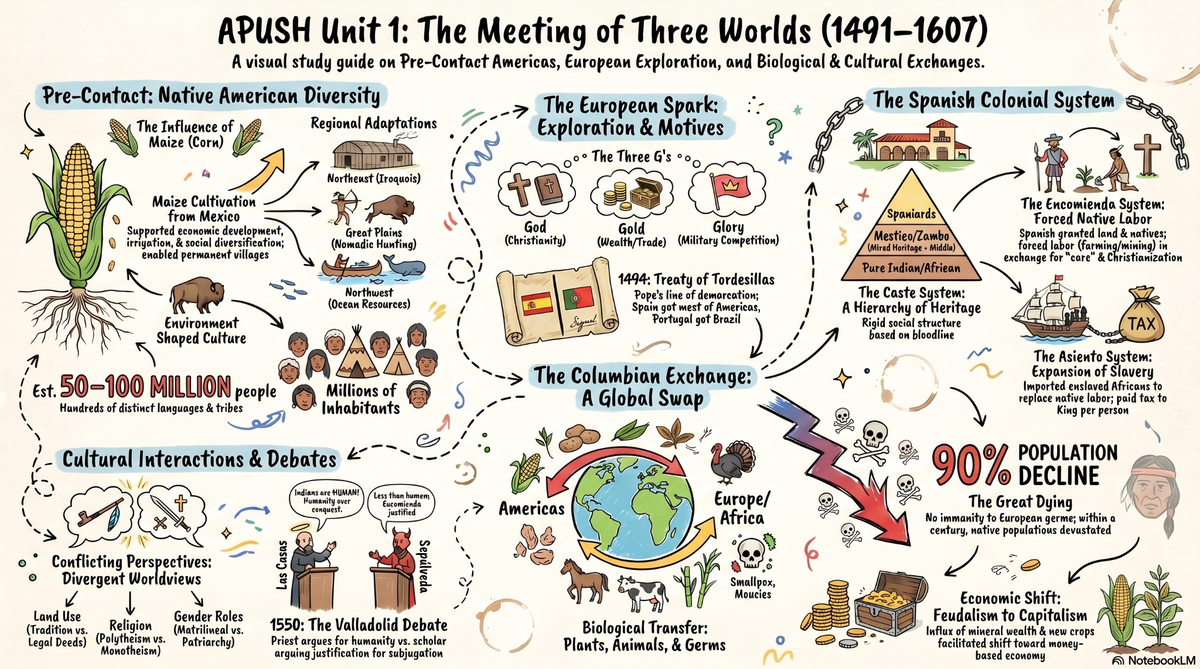
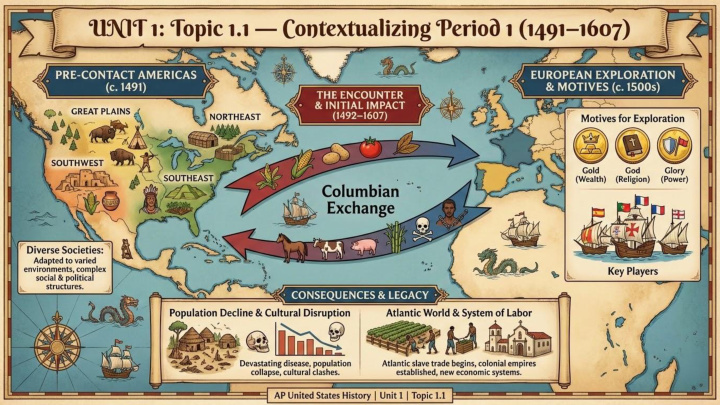
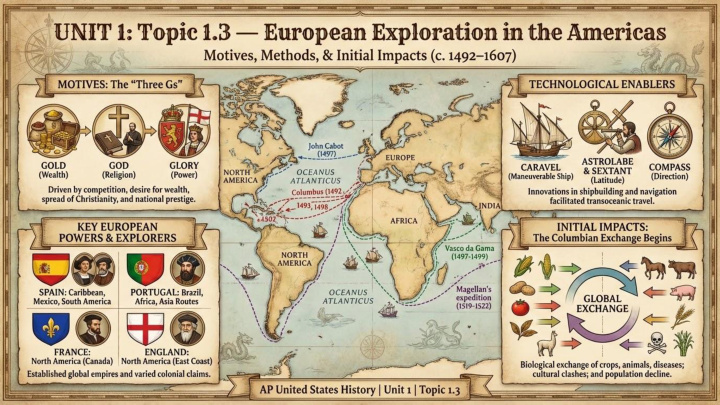
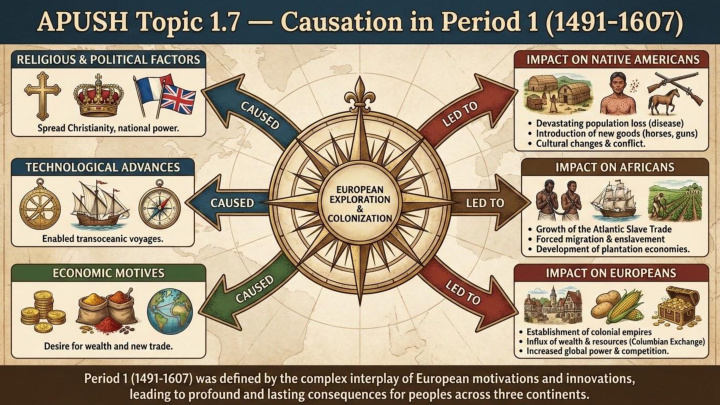
Pre-Columbian Americas, European exploration, the Columbian Exchange, and early Spanish colonization.
🎙 Episode 1 · --:--
0:00--:--
Question
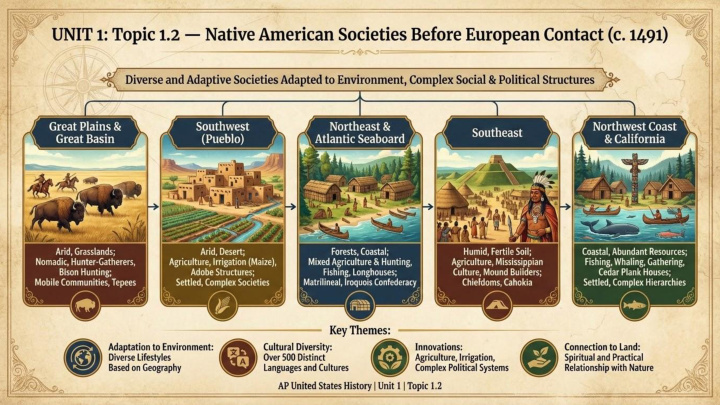
What were the major pre-Columbian civilizations of the Americas?
Unit 1 · Period 1
tap to flip
Answer
The Maya (Mesoamerica), Aztec/Mexica (central Mexico), Inca (Andes), and diverse North American cultures including the Mississippian, Pueblo, and Iroquois peoples.
Card 1 of 8
🔍
Columbian Exchange
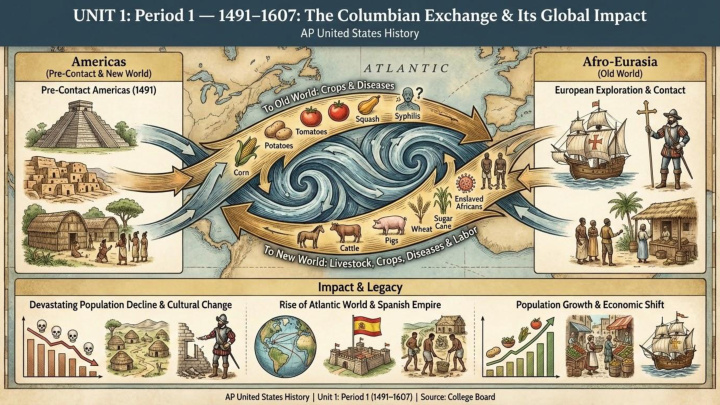
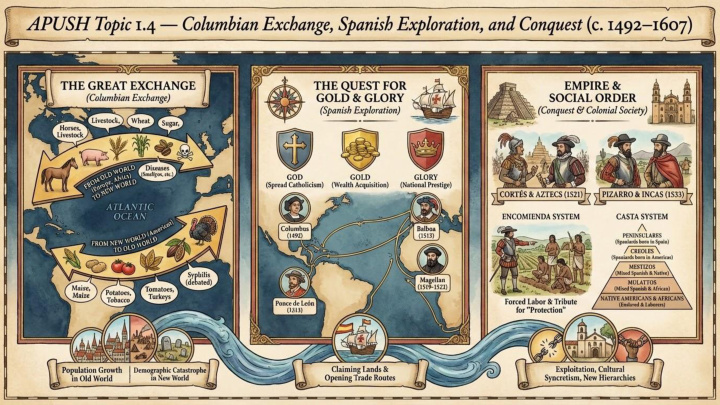
Transfer of plants, animals, diseases, and people between Eastern and Western Hemispheres after 1492.
Key Concepts
Encomienda System
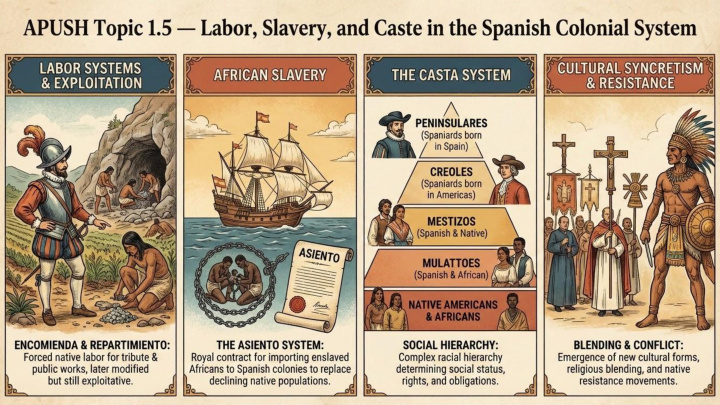
Spanish colonial labor system granting rights to extract labor from Indigenous peoples.
Colonial Systems
Conquistadors
Spanish conquerors who established Spanish colonial rule in the Americas through military force.
Spanish Colonization
Mestizo
Person of mixed European and Indigenous ancestry in Spanish colonial social hierarchy.
Colonial Society
Columbian Exchange
The widespread transfer of plants, animals, culture, and diseases between Americas and Old World.
Global Exchange
Caste System (Casta)
Spanish colonial racial hierarchy with peninsulares at top and Indigenous/Africans at bottom.
Colonial Society
Pueblo Revolt (1680)
Successful Indigenous uprising against Spanish rule in New Mexico, temporarily driving out Spanish colonizers.
Resistance
Joint-Stock Company
Business entity pooling investor capital to fund colonial ventures, spreading risk and reward.
Economics
Big Idea 1
Pre-Columbian Americas were diverse and complex — not a "New World"
The Americas were home to hundreds of sophisticated civilizations before European contact. Calling it a "New World" reflects European ignorance, not historical reality. Understanding pre-contact diversity is essential for interpreting what colonization destroyed.
Indigenous PeoplesDiversityPre-Contact
Big Idea 2
Disease was the most powerful weapon of colonization
European colonization succeeded largely because of biological catastrophe, not military superiority alone. Epidemic disease killed between 50–90% of Indigenous Americans, collapsing civilizations before most Europeans arrived. This demographic catastrophe reshaped the entire hemisphere.
Columbian ExchangeDiseaseDemographic Collapse
Big Idea 3
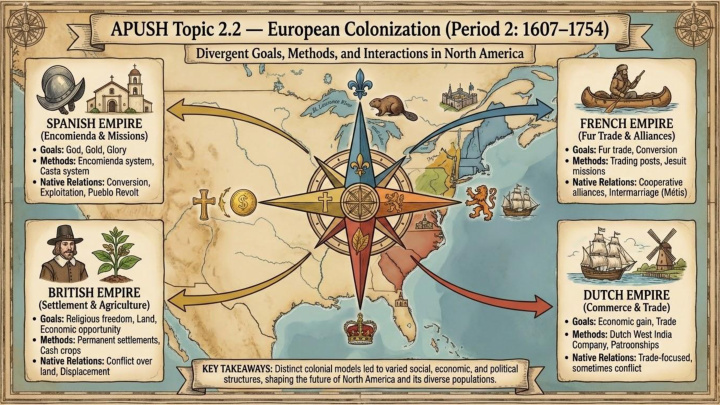
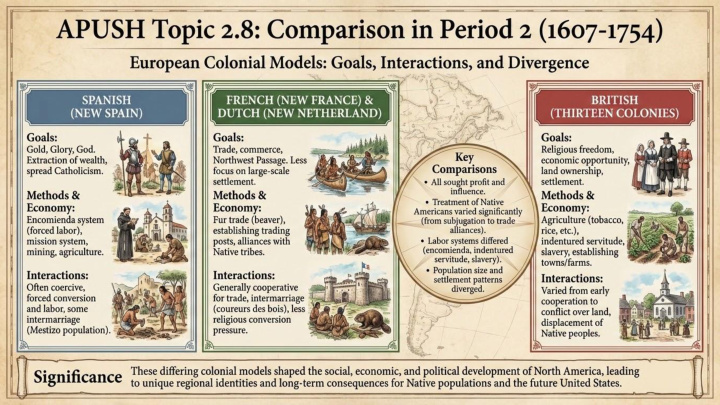
European powers had different colonization strategies with different consequences
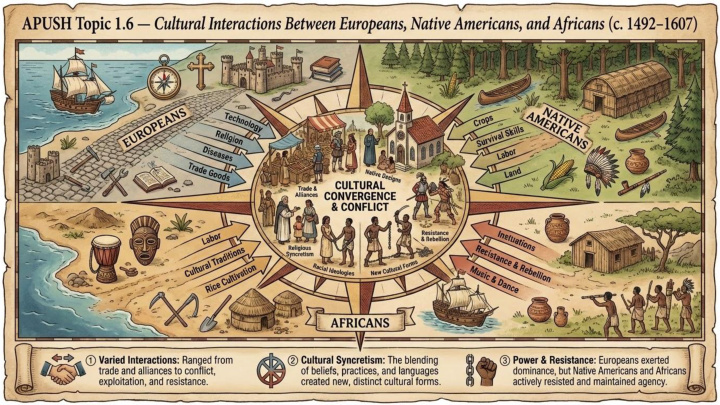
Spain extracted wealth through forced Indigenous labor; France built trade alliances; England settled and displaced. These different approaches created very different colonial societies and different legacies in the modern US, Canada, and Latin America.
ColonizationComparisonLegacy
1 / 8
Question 1 of 5Score: 0/5
2
Unit 2
Period 2: Colonial America (1607–1754)
1607–1754 · approx. 6–8% of exam
🎙
Unit 2: Period 2: Colonial America (1607–1754)
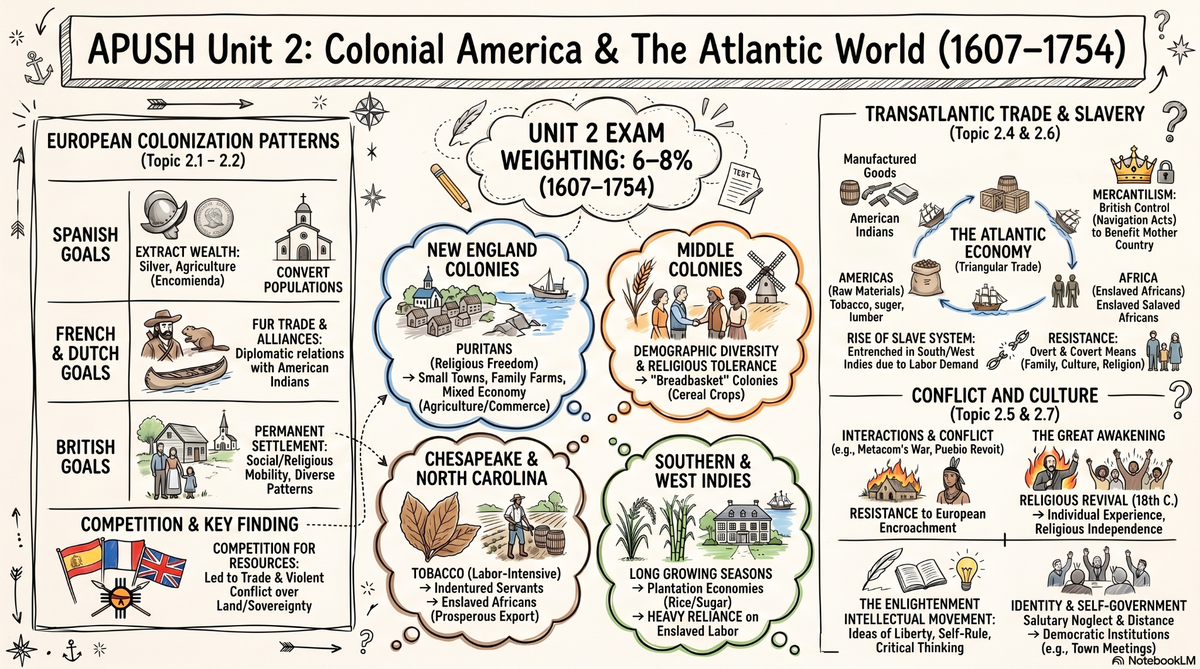
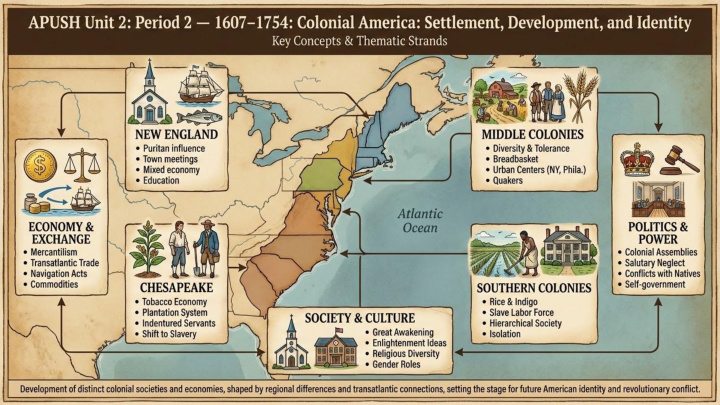
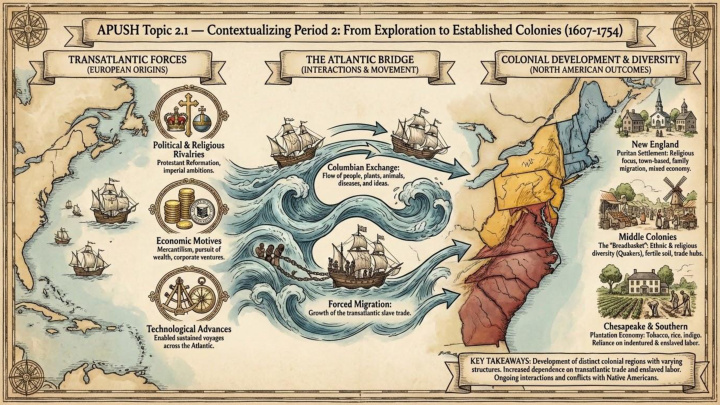
English colonial regions, Puritan New England, the Chesapeake, Atlantic trade, slavery's development, and colonial identity.
🎙 Episode 2 · --:--
0:00--:--
Question
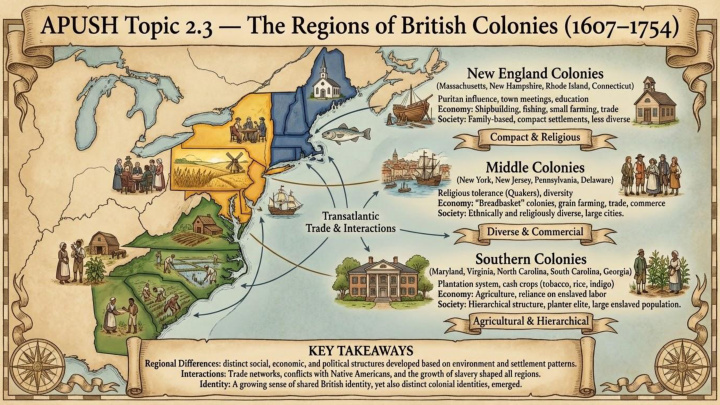
What were the three major regions of English colonial America and their characteristics?
Unit 2 · Period 2
tap to flip
Answer
New England: Puritan religion, small farms, trade. Middle Colonies: diverse, tolerant, grain farming. Chesapeake/South: tobacco/rice plantations, enslaved labor, Anglican.
Card 1 of 8
🔍
House of Burgesses
First representative assembly in English America, established in Virginia in 1619.
Self-Government
Bacon's Rebellion
1676 Virginia uprising of frontier settlers against colonial elites and Governor Berkeley.
Colonial Conflict
Headright System
Land grant system giving 50 acres to anyone who paid for their or another's passage to Virginia.
Colonial Economics
Indentured Servitude
Labor contract where servants worked for set years in exchange for passage to the colonies.
Labor Systems
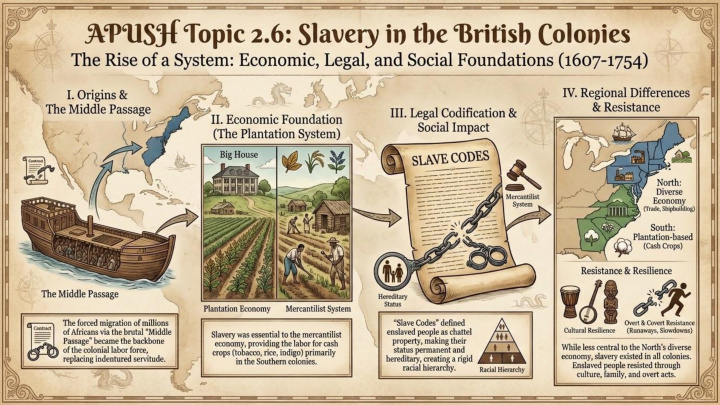
Slave Codes
Laws establishing slavery as permanent, hereditary, and race-based in colonial America.
Slavery
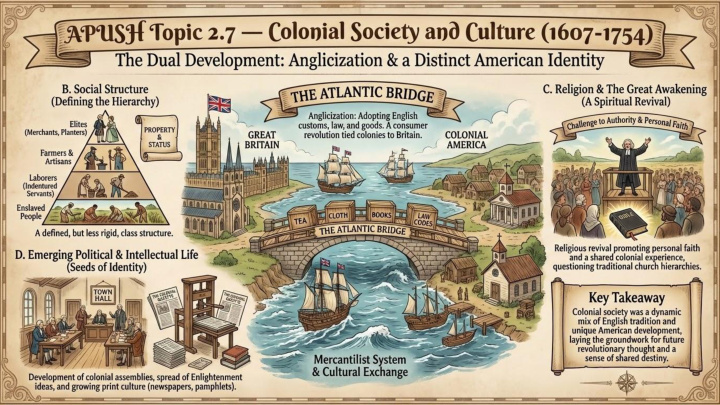
Great Awakening
Mid-18th century Protestant revival emphasizing individual religious experience; fostered democratic ideas.
Puritan compromise allowing partial church membership for those lacking full conversion experience.
Puritan Society
Big Idea 1
Colonial regions developed distinct identities — setting up later tensions
New England's Puritan communalism, the Middle Colonies' diversity and tolerance, and the South's plantation economy created three very different societies. These regional differences persisted through the Revolution, the Constitution, and eventually the Civil War.
RegionalismColonial SocietyIdentity
Big Idea 2
Slavery's development was deliberate — not inevitable
Virginia planters deliberately chose African slavery over indentured servitude after Bacon's Rebellion, creating race-based slave codes. Slavery was a political and economic choice, not an inevitable outcome. This choice shaped American society for centuries.
SlaveryRaceEconomics
Big Idea 3
Colonial America developed habits of self-government that Britain later threatened
Through salutary neglect, colonial assemblies, and local governance, Americans developed expectations of self-rule. When Britain tried to reassert control after 1763, colonists experienced it as tyranny — making revolution feel necessary.
Self-GovernmentSalutary NeglectRevolution
1 / 9
Question 1 of 5Score: 0/5
3
Unit 3
Period 3: Revolution & the New Nation (1754–1800)
1754–1800 · approx. 10–17% of exam
🎙
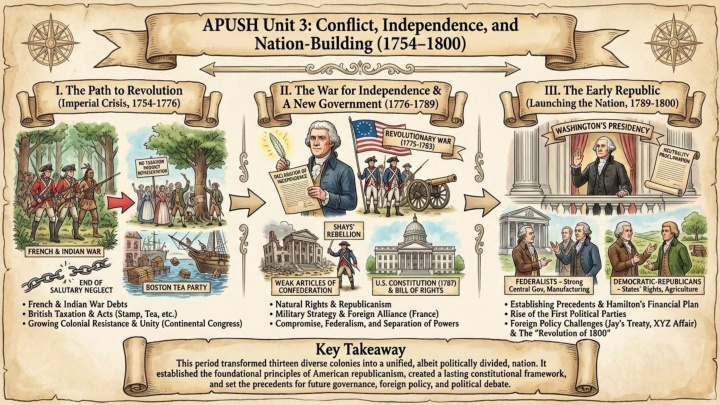
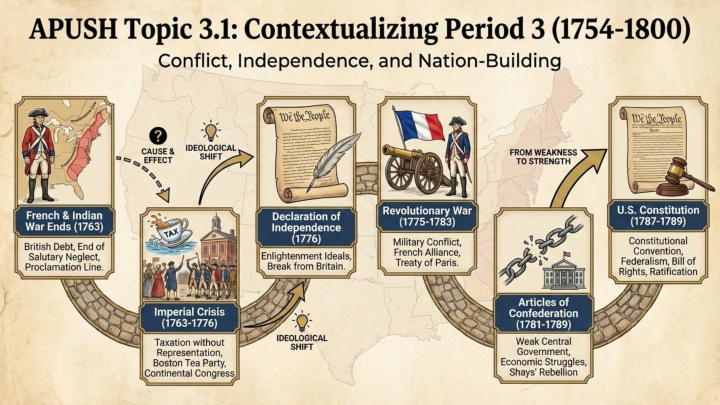
Unit 3: Period 3: Revolution & the New Nation (1754–1800)
French & Indian War, causes of Revolution, the Declaration, Constitution, and the challenges of building a new republic.
🎙 Episode 3 · --:--
0:00--:--
Question
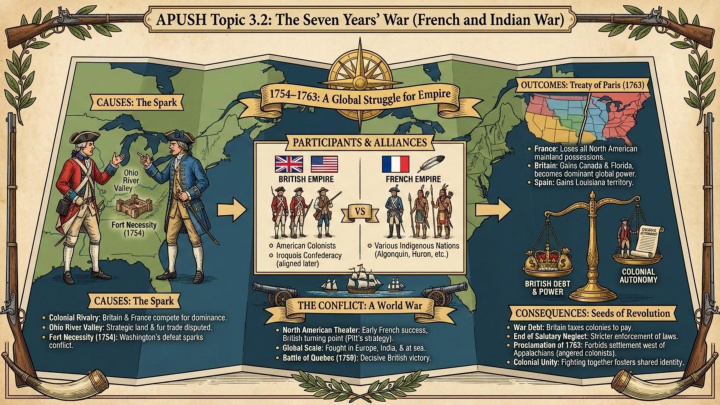
How did the French and Indian War contribute to the American Revolution?
Unit 3 · Period 3
tap to flip
Answer
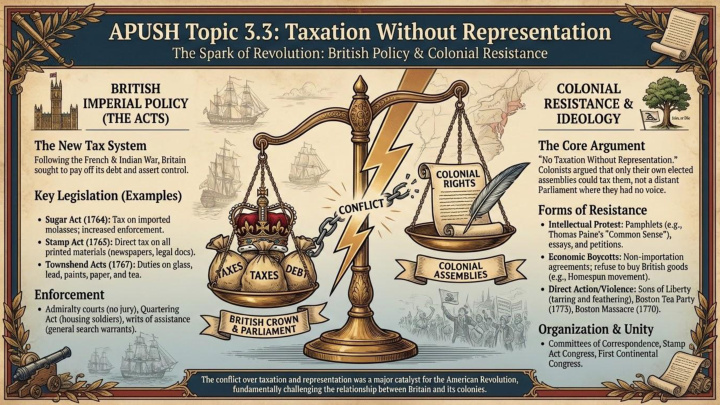
Britain's massive war debt led to new taxes on colonists. The war also gave colonists military experience and a sense of shared identity, while Britain's arrogance toward colonial troops created resentment.
Card 1 of 8
🔍
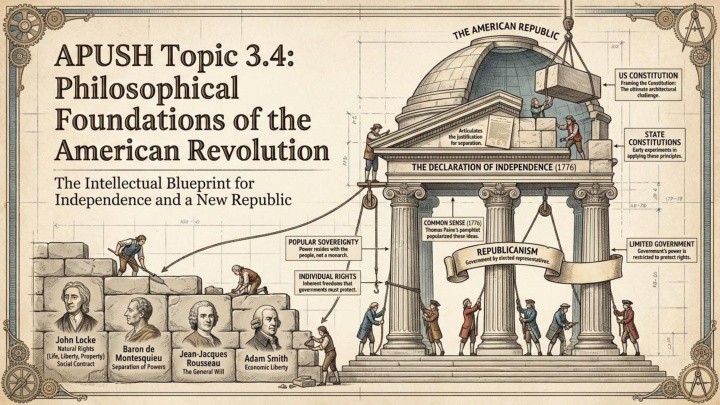
Natural Rights
Rights inherent to all humans (life, liberty, property) that government cannot legitimately take away — Locke's foundation for revolution.
Enlightenment Ideas
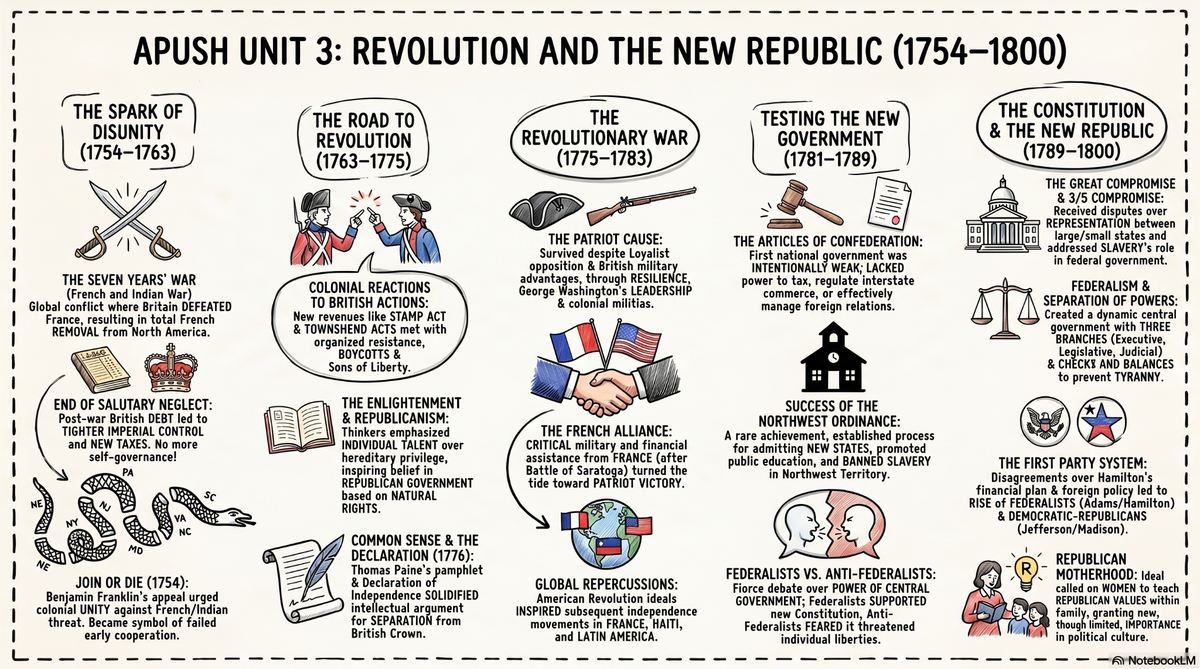
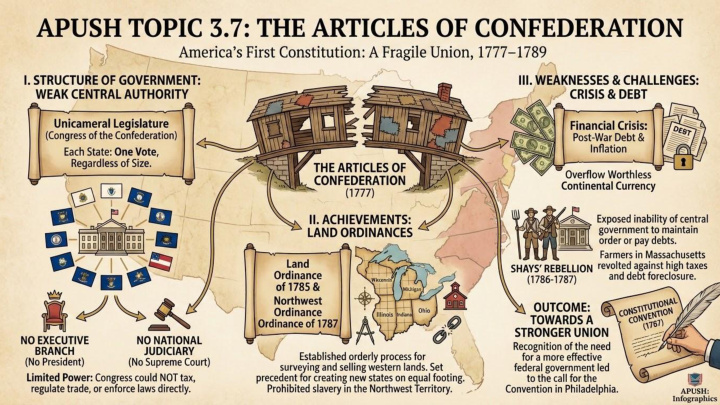
Articles of Confederation
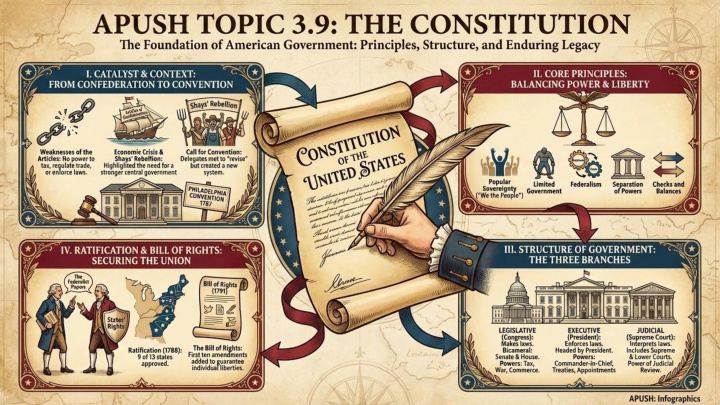
America's first constitution (1781); created weak central government with no taxing or commerce power.
Government
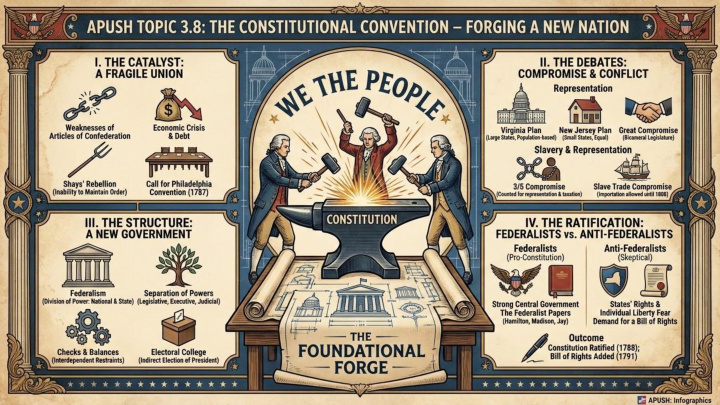
Constitutional Convention
1787 Philadelphia meeting that replaced the Articles with the US Constitution.
Government
Great Compromise
Created bicameral Congress: House based on population, Senate with equal state representation.
Constitution
Three-Fifths Compromise
Counted enslaved people as 3/5 of a person for congressional representation and taxation.
Constitution
Federalist Papers
Essays by Hamilton, Madison, Jay arguing for Constitutional ratification.
Political Thought
Bill of Rights
First ten constitutional amendments protecting individual liberties from federal government.
Civil Liberties
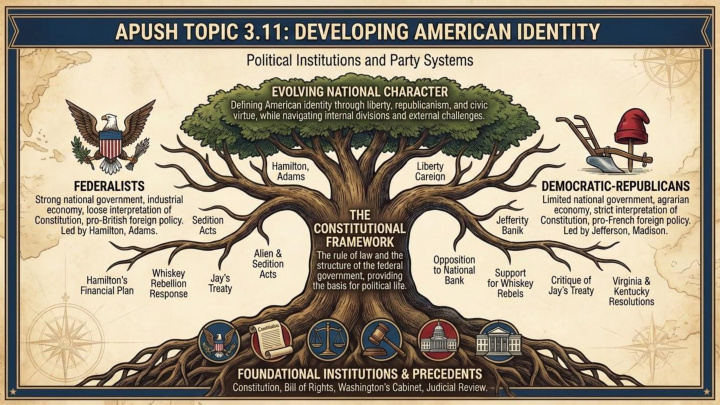
Alien and Sedition Acts
1798 laws restricting immigration and criminalizing criticism of government — sparked states' rights debate.
Political Conflict
Big Idea 1
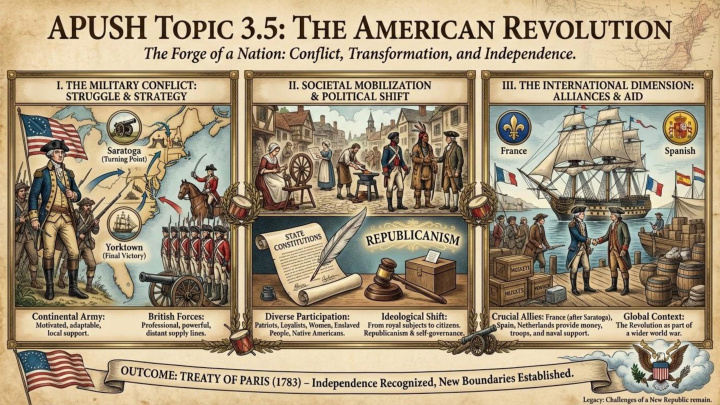
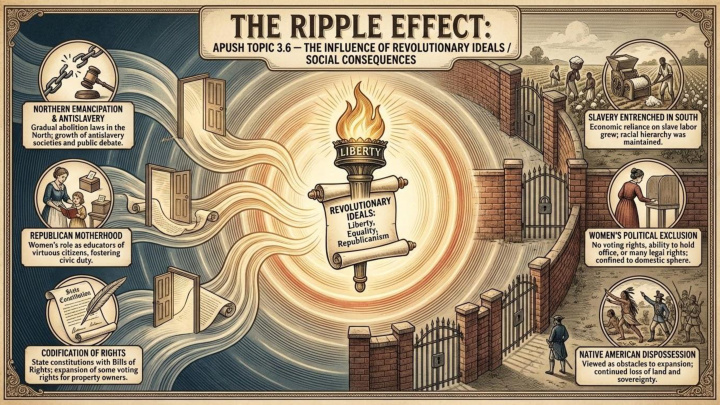
The Revolution was both radical and limited
The Declaration's language of equality was revolutionary — but the Revolution left slavery intact, excluded women from political life, and displaced Indigenous peoples. The tension between the Revolution's ideals and its limits defined American political conflict for generations.
RevolutionEqualityContradiction
Big Idea 2
The Constitution was a bundle of compromises — especially on slavery
The three-fifths compromise, the slave trade clause, and the fugitive slave clause embedded slavery into the Constitution. The founders knew this was a contradiction — and chose union over abolition. This choice made the Civil War almost inevitable.
ConstitutionSlaveryCompromise
Big Idea 3
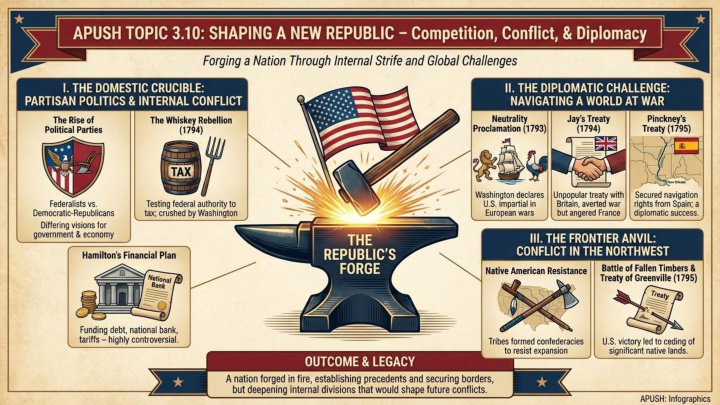
The first party system revealed fundamental disagreements about government
Federalists and Democratic-Republicans disagreed about the size and power of the federal government, the role of commerce vs. agriculture, and the interpretation of the Constitution. These disagreements were never resolved — they echo in American politics today.
Political PartiesFederalismDebate
1 / 13
Question 1 of 5Score: 0/5
4
Unit 4
Period 4: Expansion & Reform (1800–1848)
1800–1848 · approx. 10–17% of exam
🎙
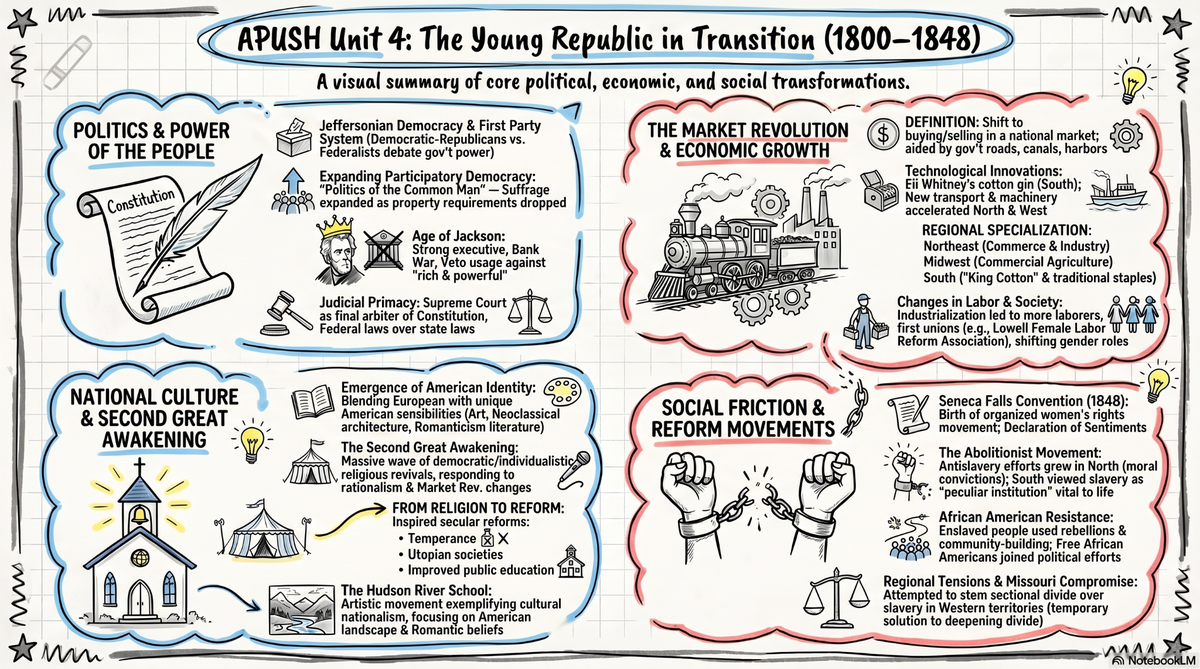
Unit 4: Period 4: Expansion & Reform (1800–1848)
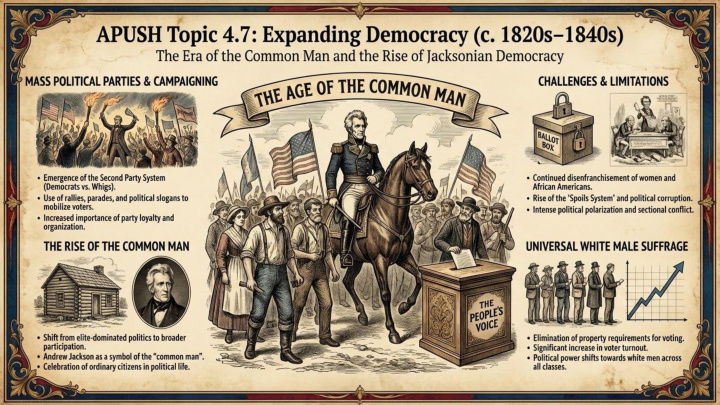
Jeffersonian democracy, the Market Revolution, Jacksonian era, westward expansion, and antebellum reform movements.
🎙 Episode 4 · --:--
0:00--:--
Question
What was the significance of the "Revolution of 1800"?
Unit 4 · Period 4
tap to flip
Answer
Jefferson's election was the first peaceful transfer of power between opposing parties in American history — proving the constitutional system could work. Jefferson called it a "revolution" because it ended Federalist dominance.
Card 1 of 8
🔍
Louisiana Purchase
1803 US acquisition of ~828,000 sq mi from France, doubling national territory.
Territorial Expansion
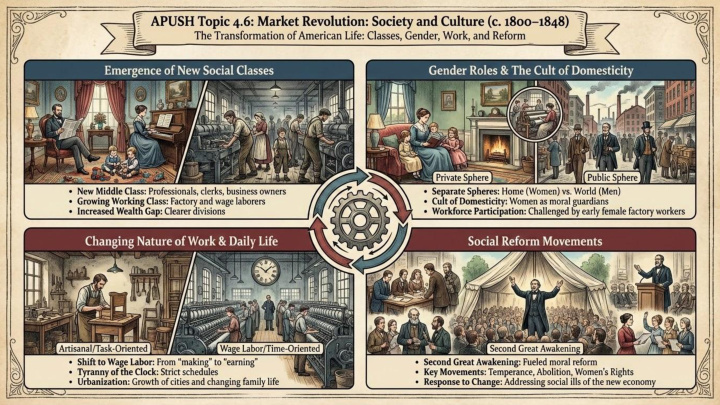
Market Revolution
Early 19th century transformation linking American economy through industrialization and transportation improvements.
Economics
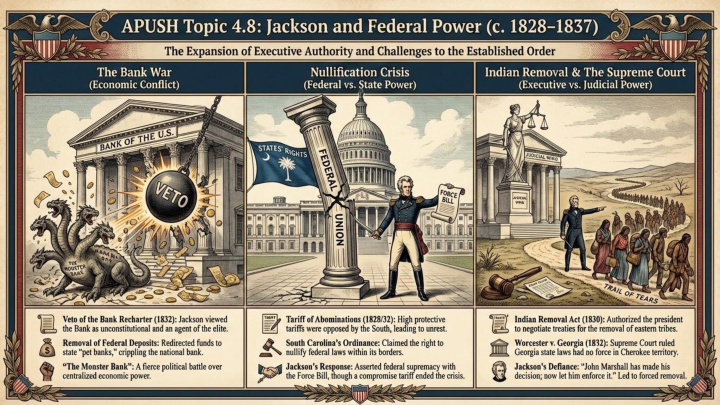
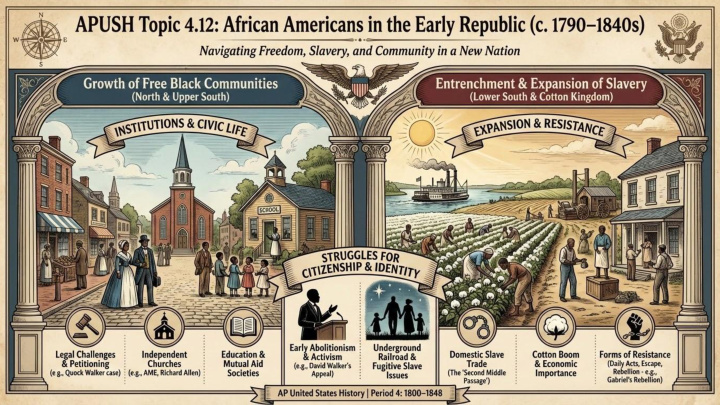
Indian Removal Act (1830)
Law authorizing forced relocation of southeastern Indigenous nations west of the Mississippi.
Native Americans
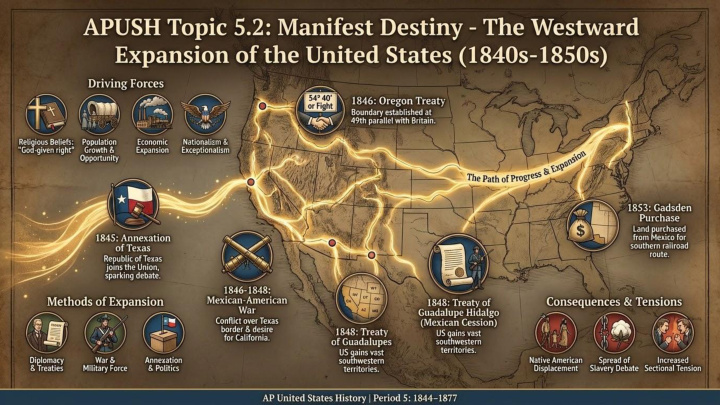
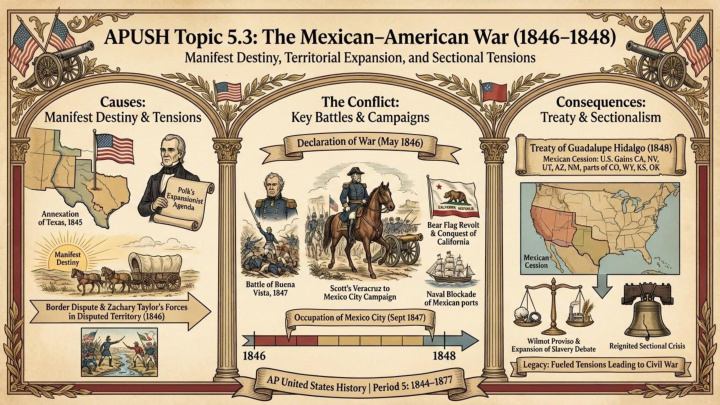
Manifest Destiny
Belief that US westward expansion to the Pacific was inevitable and divinely sanctioned.
Expansion
Missouri Compromise (1820)
Maintained Senate balance by admitting Missouri (slave) and Maine (free); banned slavery north of 36°30'.
Sectional Conflict
Nullification Crisis
South Carolina's 1832 claim that states could void federal laws — Jackson's response asserted federal supremacy.
States' Rights
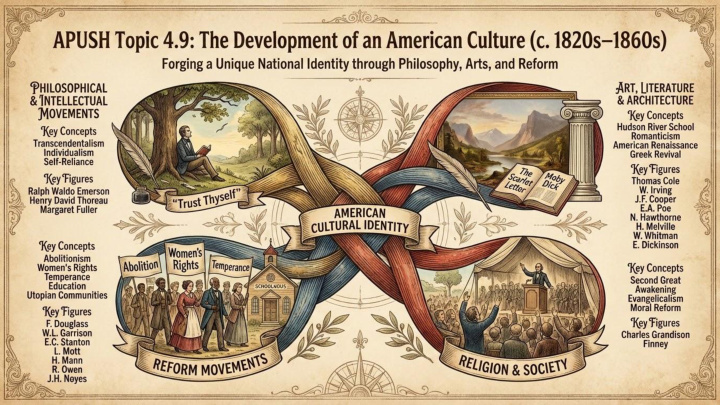
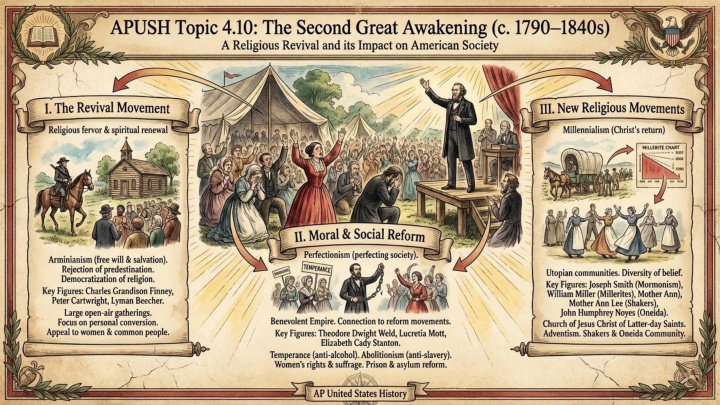
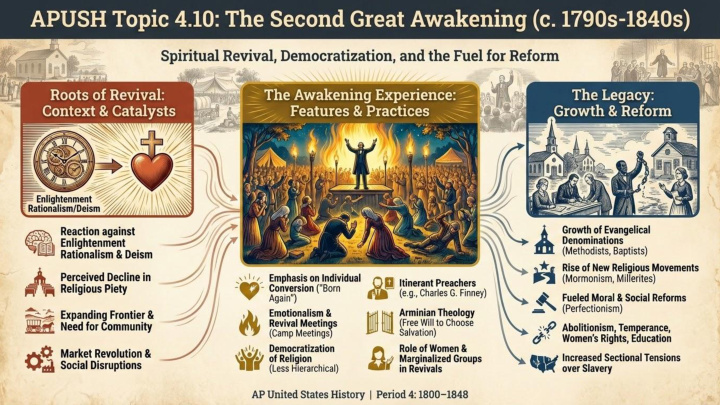
Second Great Awakening
Early 19th century Protestant revival that fueled reform movements including abolitionism and temperance.
Religion & Reform
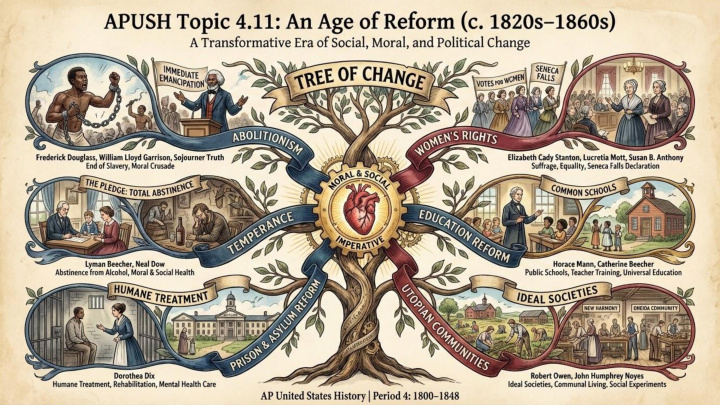
Seneca Falls Convention (1848)
First women's rights convention; issued Declaration of Sentiments demanding equality including suffrage.
Women's Rights
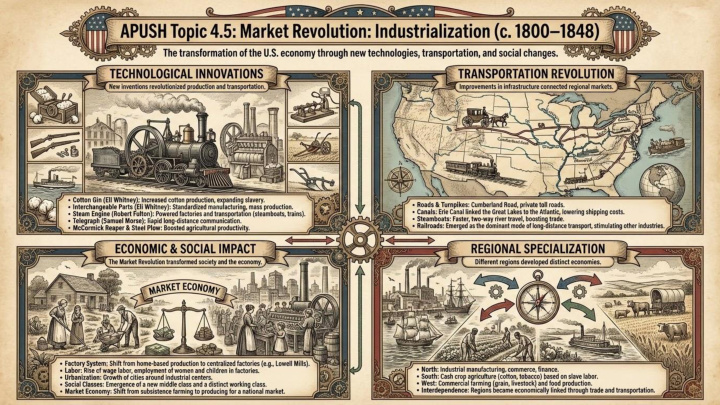
Big Idea 1
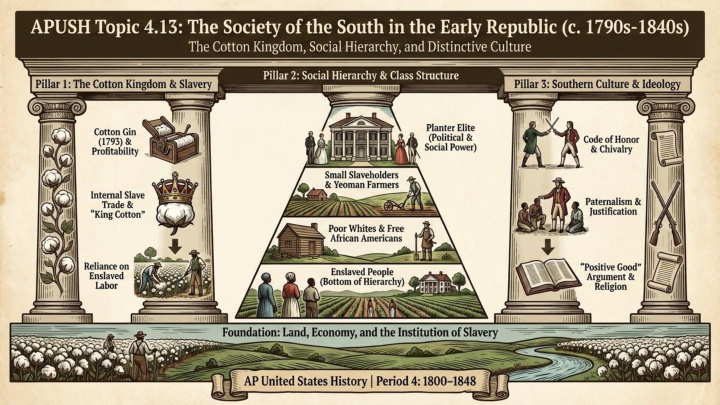
The Market Revolution transformed American society and created new tensions
Industrialization, canals, and railroads connected the nation economically — but also created a new class of urban workers, deepened regional specialization (cotton South, industrial North), and raised new questions about labor, inequality, and the role of government.
Market RevolutionIndustrializationClass
Big Idea 2
Manifest Destiny drove expansion — but at enormous human cost
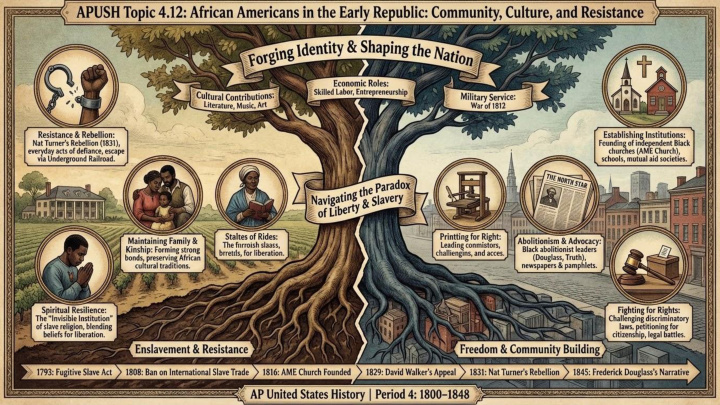
Westward expansion fulfilled white Americans' aspirations but devastated Indigenous nations through forced removal, broken treaties, and violence. It also intensified the slavery question by forcing Congress to repeatedly decide whether new territories would be slave or free.
Manifest DestinyIndigenous PeoplesSlavery
Big Idea 3
Antebellum reform movements reflected both religious revivalism and Enlightenment ideals
The Second Great Awakening fueled abolitionism, temperance, and women's rights by arguing that human improvement was possible and required. These movements challenged the contradiction between American ideals of freedom and the reality of slavery and gender inequality.
ReformAbolitionismWomen's Rights
1 / 17
Question 1 of 5Score: 0/5
5
Unit 5
Period 5: Civil War & Reconstruction (1844–1877)
1844–1877 · approx. 10–17% of exam
🎙
Unit 5: Period 5: Civil War & Reconstruction (1844–1877)
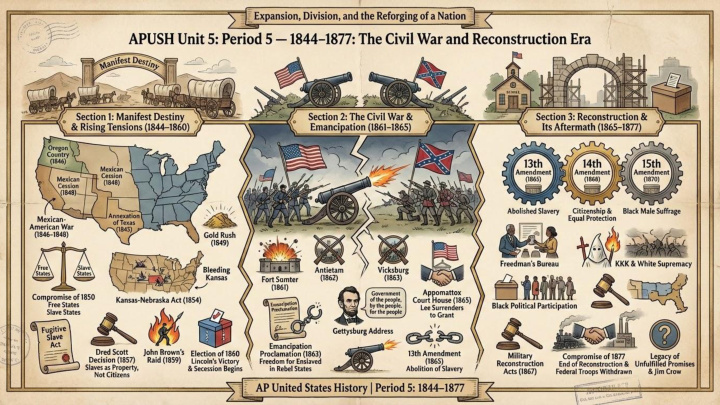
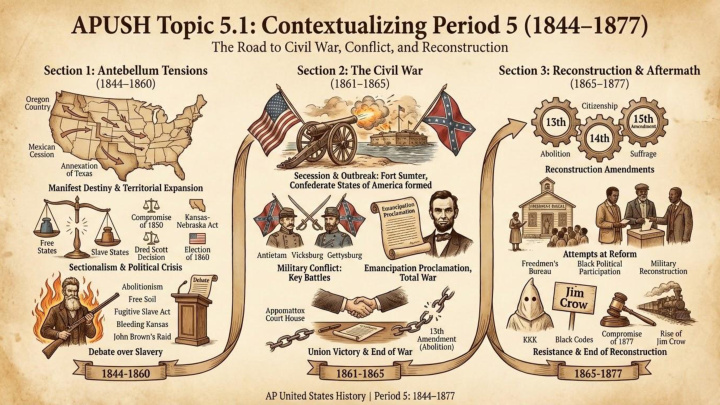
Causes of the Civil War, the war itself, emancipation, and the successes and failures of Reconstruction.
🎙 Episode 5 · --:--
0:00--:--
Question
What were the main causes of the Civil War?
Unit 5 · Period 5
tap to flip
Answer
Slavery (especially its expansion into new territories), states' rights (specifically the right to maintain slavery), sectionalism (North vs. South economic and cultural differences), and the failure of political compromise.
Card 1 of 8
🔍
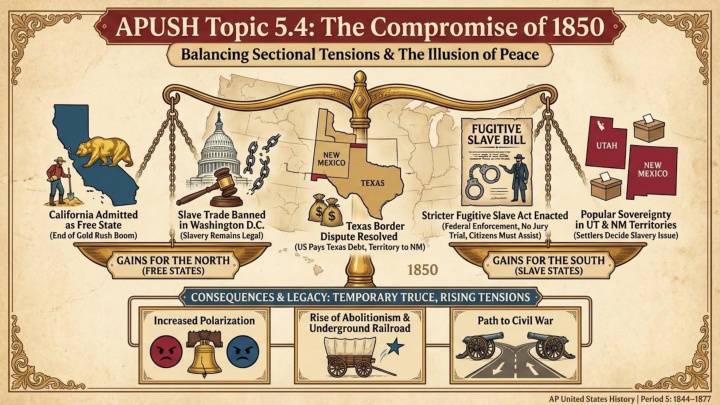
Compromise of 1850
Sectional agreement admitting California free, establishing popular sovereignty elsewhere, strengthening Fugitive Slave Act.
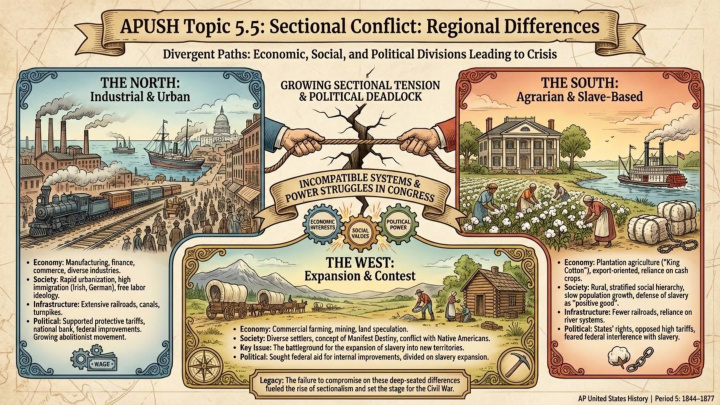
Sectional Conflict
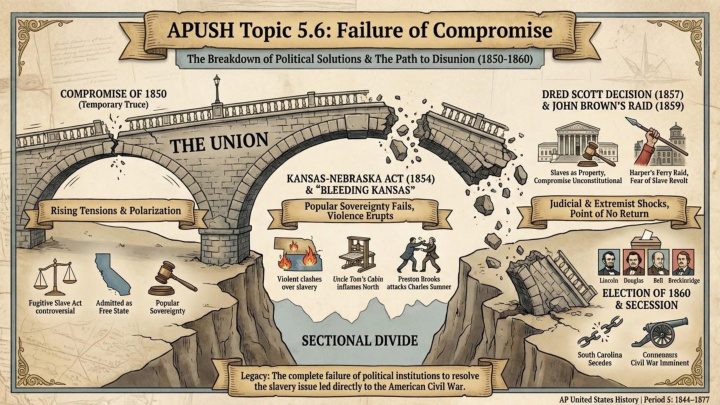
Kansas-Nebraska Act
1854 law establishing popular sovereignty in new territories, destroying the Missouri Compromise.
Sectional Conflict
Popular Sovereignty
Principle that settlers of a territory should decide for themselves whether to allow slavery.
Political Concepts
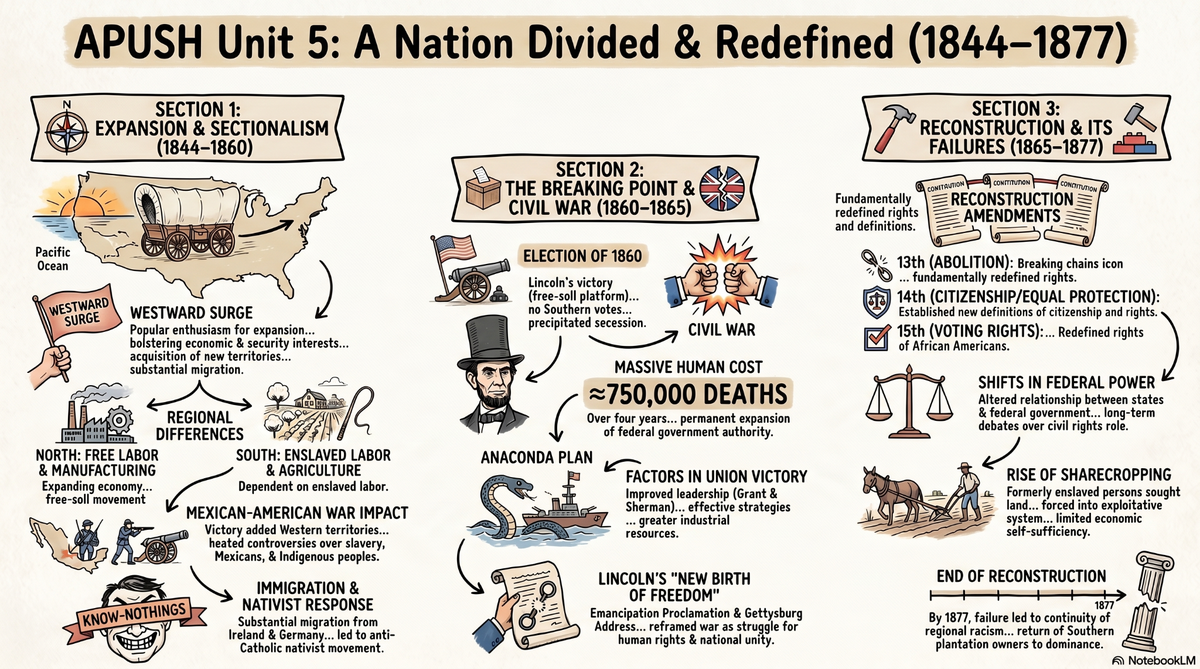
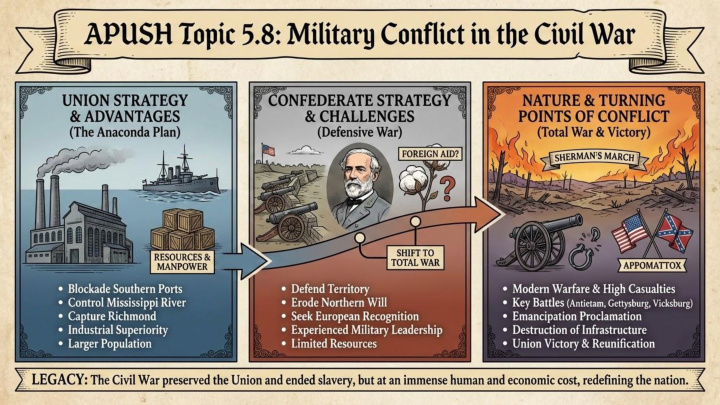
Emancipation Proclamation
1863 executive order freeing enslaved people in Confederate states in rebellion.
Civil War
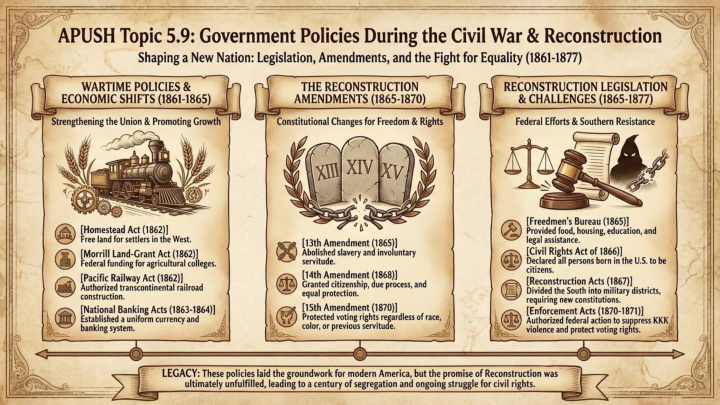
Reconstruction Amendments
13th (abolition), 14th (citizenship/equal protection), 15th (Black male suffrage).
Reconstruction
Freedmen's Bureau
Federal agency providing assistance to formerly enslaved people and poor whites in the postwar South.
Reconstruction
Sharecropping
Post-Civil War labor system trapping Black farmers in debt cycles on white-owned land.
Post-War South
Compromise of 1877
Deal ending Reconstruction by withdrawing federal troops from the South in exchange for Hayes's presidency.
Reconstruction's End
Big Idea 1
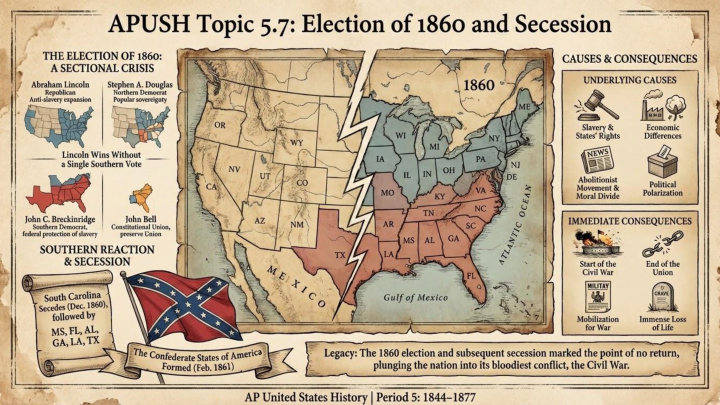
Slavery was the central cause of the Civil War
Despite the "Lost Cause" mythology claiming states' rights were the cause, secession documents explicitly state slavery as the reason for leaving the Union. The war was fundamentally about whether slavery would expand or be contained — and ultimately, whether it would survive.
SlaveryCivil War CausesCausation
Big Idea 2
The Civil War transformed the nature of federal power
The war dramatically expanded federal authority — income taxes, conscription, a national banking system, and ultimately constitutional amendments redefining citizenship. It settled the question of whether states could secede, but raised new ones about federal power.
Federal PowerConstitutional ChangeTransformation
Big Idea 3
Reconstruction promised freedom but largely failed to deliver it
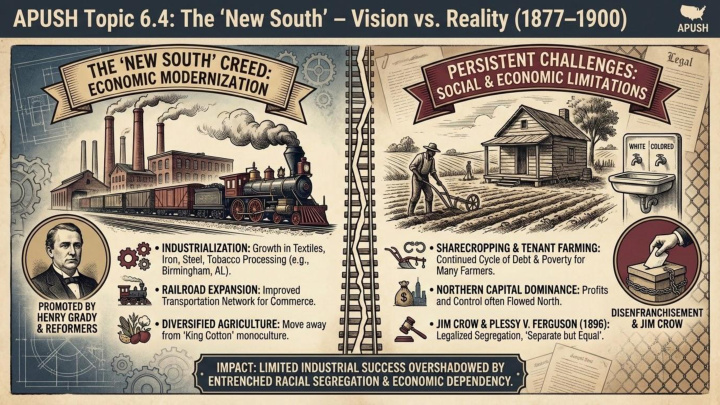
The 13th, 14th, and 15th Amendments were revolutionary in principle — but Reconstruction's failure left Black Americans subject to sharecropping, Jim Crow, and terror for another century. Understanding why Reconstruction failed is essential for understanding American racial history.
ReconstructionFailureRace
1 / 10
Question 1 of 5Score: 0/5
6
Unit 6
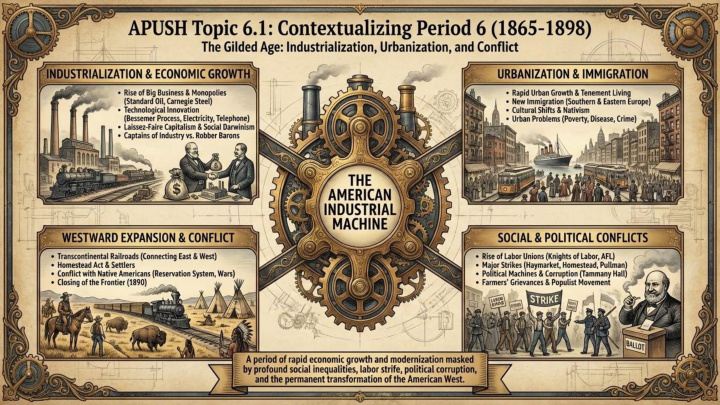
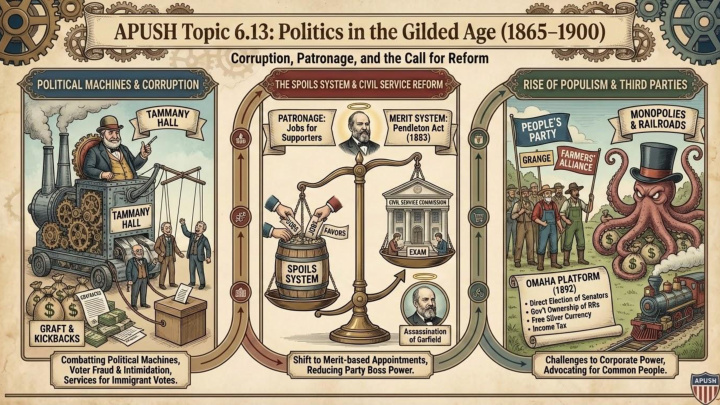
Period 6: The Gilded Age (1865–1898)
1865–1898 · approx. 10–17% of exam
🎙
Unit 6: Period 6: The Gilded Age (1865–1898)
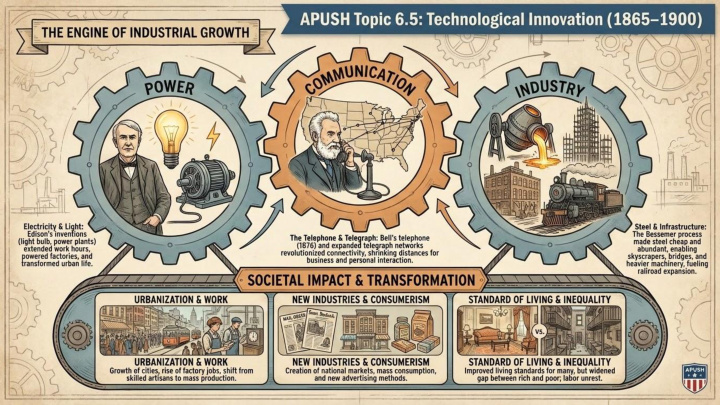
Industrialization, the Gilded Age's robber barons, Populism, immigration, and the closing of the frontier.
🎙 Episode 6 · --:--
0:00--:--
Question
What defined the "Gilded Age"?
Unit 6 · Period 6
tap to flip
Answer
Mark Twain's term for the late 19th century — a glittering surface of prosperity concealing deep social problems: extreme inequality, political corruption, labor exploitation, and racial violence.
Card 1 of 8
🔍
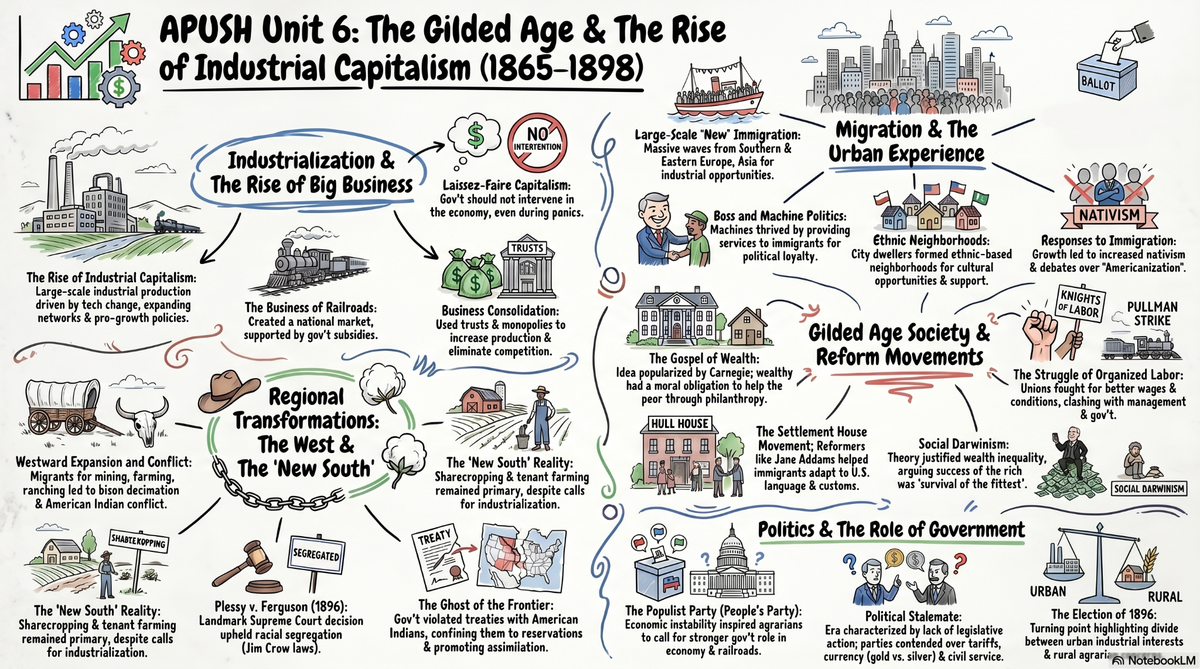
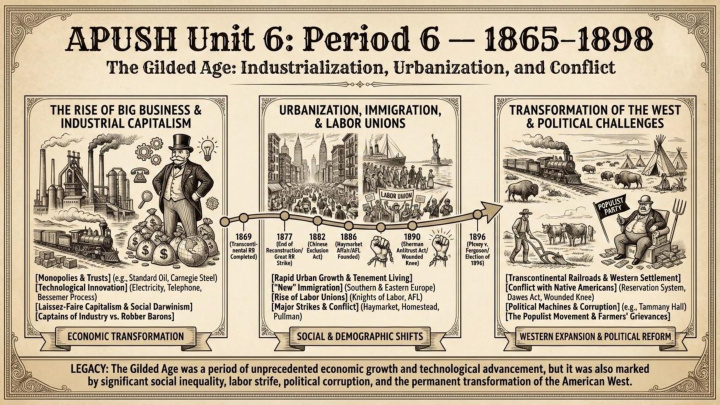
Gilded Age
Mark Twain's term for late 19th century America — prosperous surface concealing deep inequality and corruption.
Historical Period
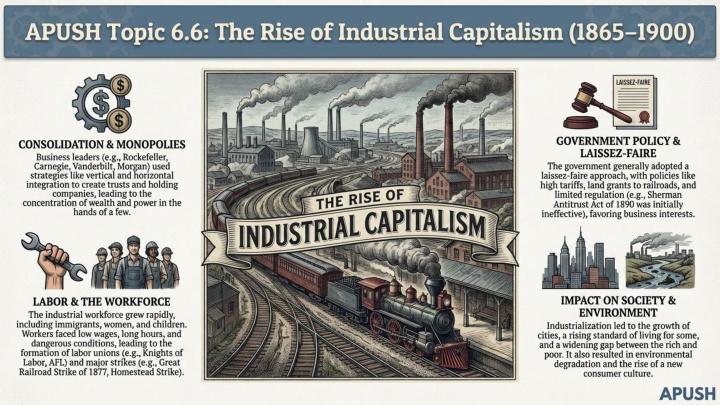
Vertical Integration
Controlling all stages of production from raw materials to finished product (Carnegie's steel).
Business Practices
Horizontal Integration
Merging with or buying competitors to control an entire industry (Rockefeller's Standard Oil).
Business Practices
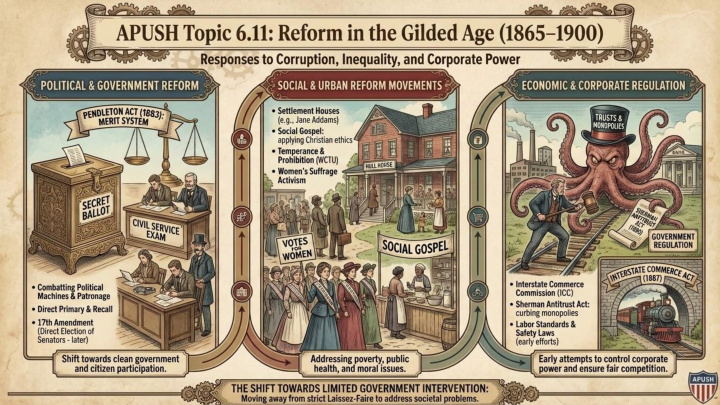
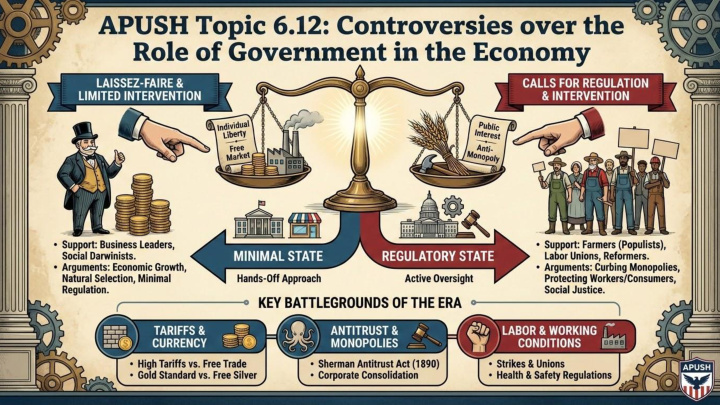
Sherman Antitrust Act (1890)
First federal law banning monopolistic business practices; rarely enforced initially.
Government Regulation
Social Darwinism
Misapplication of evolution to justify economic inequality as "natural selection."
Ideology
Gospel of Wealth
Carnegie's argument that the wealthy have a duty to use fortunes for public benefit.
Ideology
Populist Party
Late 19th century agrarian political movement demanding railroad regulation, silver coinage, and democratic reforms.
Political Movements
Turner's Frontier Thesis
Argument that the frontier experience shaped American democracy and individualism.
Historical Interpretation
Big Idea 1
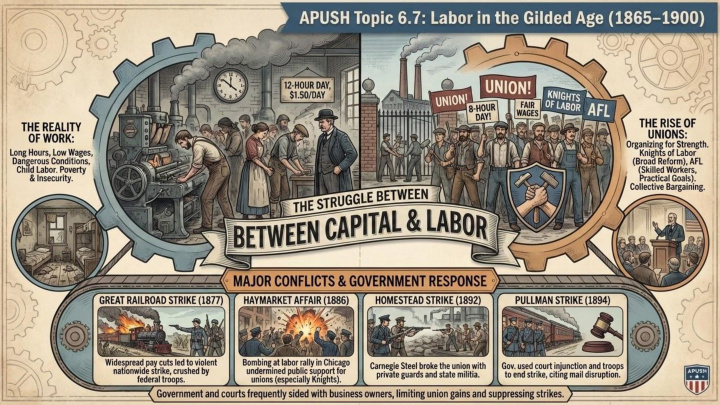
Industrialization created unprecedented wealth — and unprecedented inequality
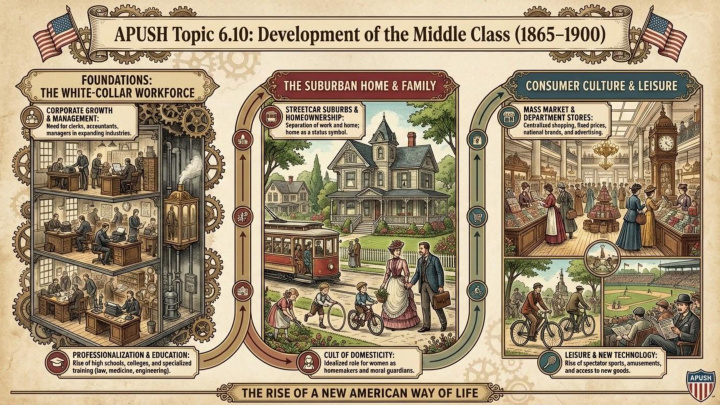
The Gilded Age produced the wealthiest individuals in American history alongside some of the worst working conditions. This concentration of wealth in the hands of a few ("robber barons") and the exploitation of workers planted the seeds of Progressive Era reforms.
IndustrializationInequalityWealth
Big Idea 2
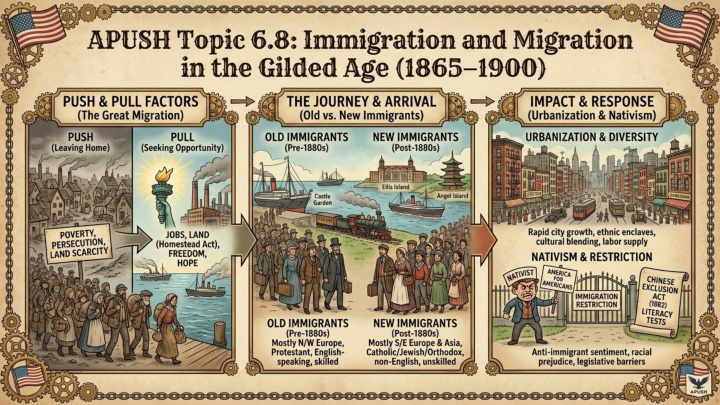
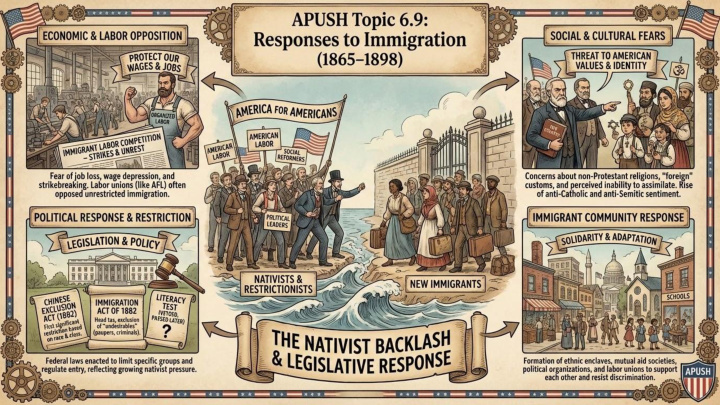
Immigration transformed American society and triggered nativist backlash
The "New Immigration" (1880s–1920s) brought millions from Southern and Eastern Europe to American cities. They transformed urban culture, provided industrial labor, and triggered nativist reactions — the Chinese Exclusion Act (1882) was the first major immigration restriction.
ImmigrationNativismUrban Life
Big Idea 3
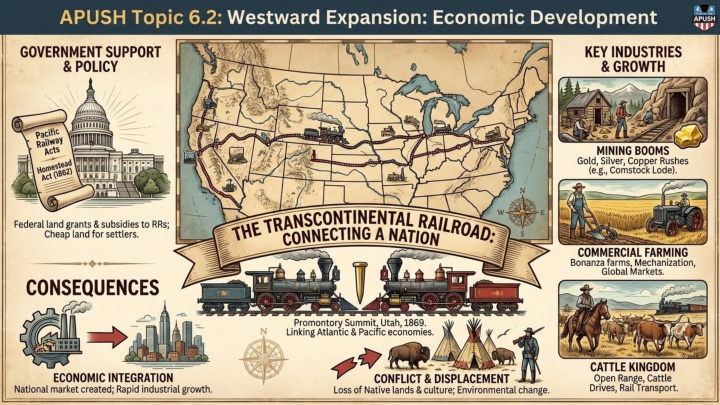
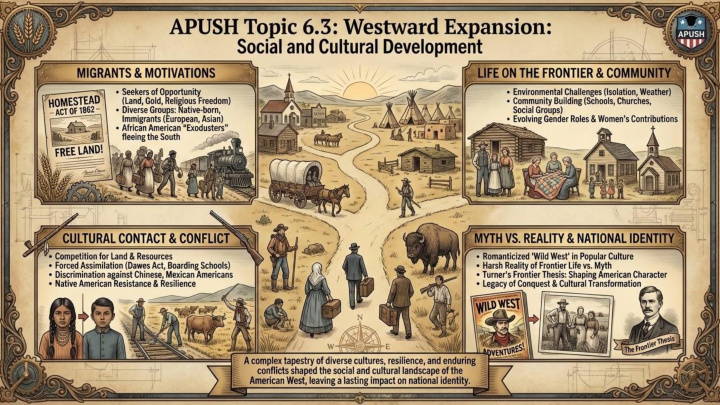
The West was "won" through conquest, not just settlement
The mythology of rugged frontier settlers obscures the systematic destruction of Indigenous nations through military force, broken treaties, and the near-extermination of the buffalo. Wounded Knee (1890) marked the end of armed Indigenous resistance — and the Dawes Act attempted cultural genocide through forced assimilation.
WestIndigenous PeoplesConquest
1 / 14
Question 1 of 5Score: 0/5
7
Unit 7
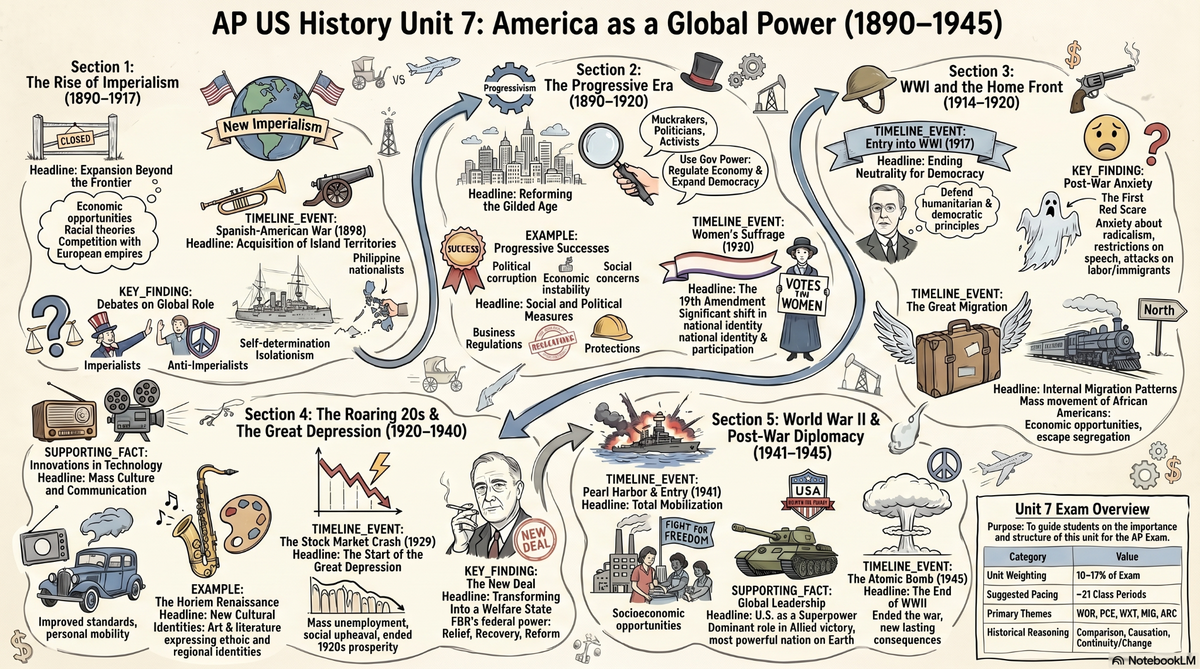
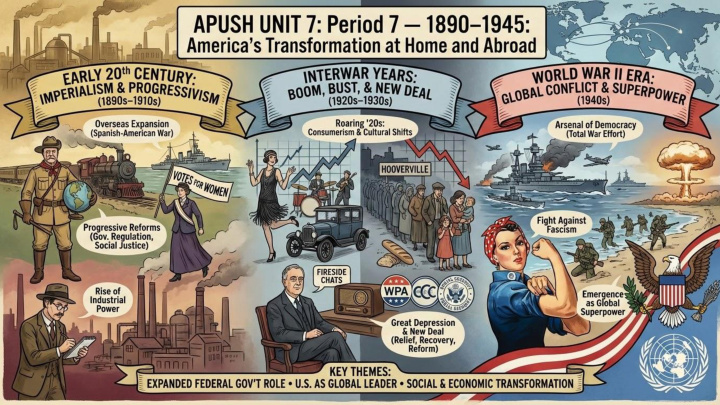
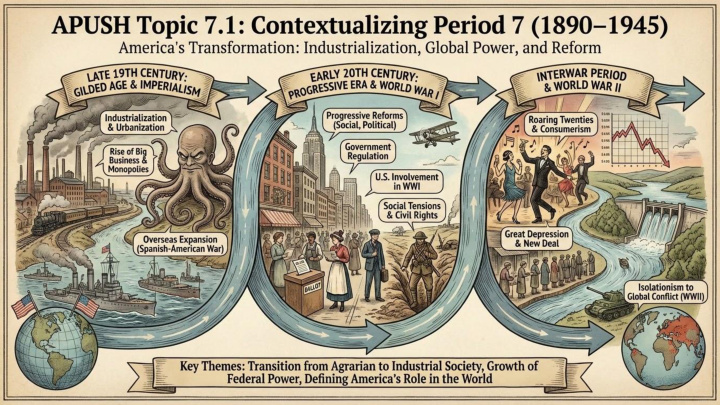
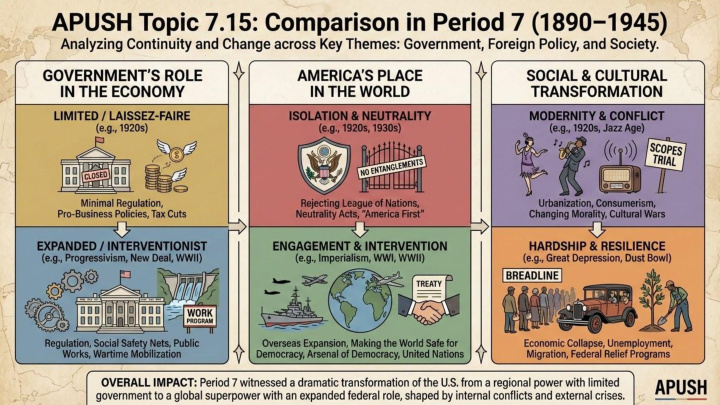
Period 7: The Progressive Era through WWI (1890–1945)
1890–1945 · approx. 10–17% of exam
🎙
Unit 7: Period 7: The Progressive Era through WWI (1890–1945)
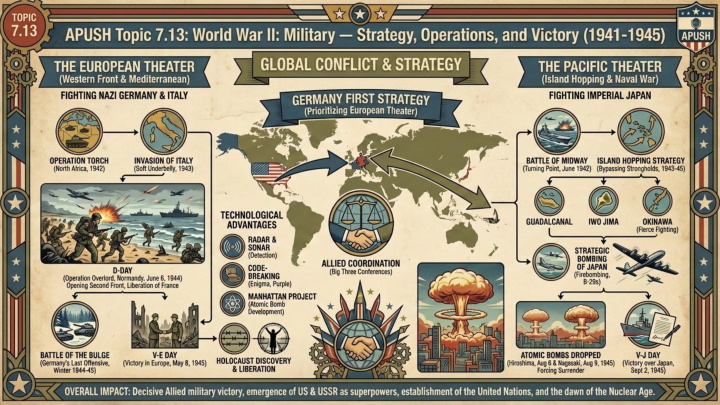
Progressive reforms, imperialism, World War I, the 1920s, Great Depression, New Deal, and World War II.
🎙 Episode 7 · --:--
0:00--:--
Question
What were the major goals of the Progressive movement?
Unit 7 · Period 7
tap to flip
Answer
Regulating big business (trust-busting), protecting workers (safety laws, child labor), expanding democracy (direct primaries, initiative/referendum, 17th Amendment), and social reform (temperance, settlement houses).
Card 1 of 8
🔍
Muckrakers
Progressive Era investigative journalists exposing corruption and social problems (Upton Sinclair, Ida Tarbell).
Progressivism
16th Amendment
Authorized federal income tax (1913).
Progressive Reforms
17th Amendment
Established direct election of US Senators (1913).
Progressive Reforms
18th Amendment
Established Prohibition — banning manufacture and sale of alcohol (1919).
Progressive Reforms
19th Amendment
Granted women the right to vote (1920).
Women's Suffrage
Great Migration
Movement of approximately 6 million Black Americans from the South to northern cities (1910–1970).
Demographics
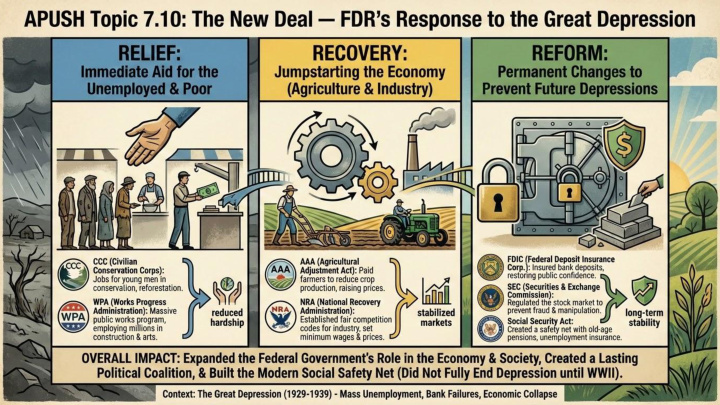
New Deal
FDR's programs addressing Great Depression through relief, recovery, and reform.
Economics
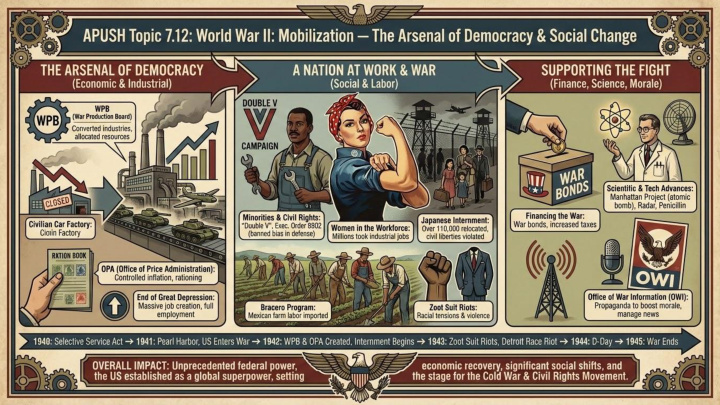
Executive Order 9066
FDR's order authorizing Japanese American internment during WWII.
Civil Liberties
Big Idea 1
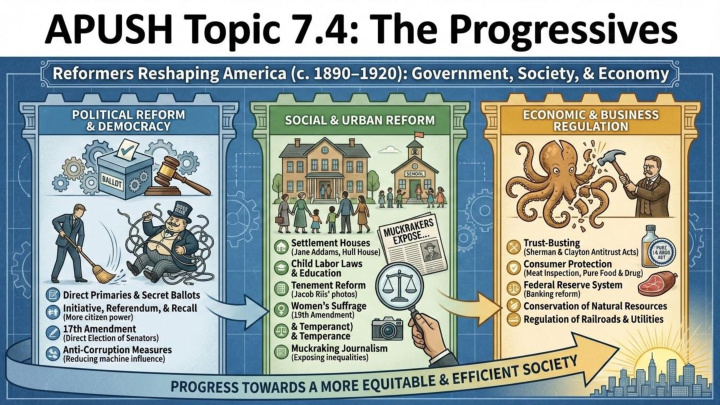
Progressivism was a response to the excesses of industrialization
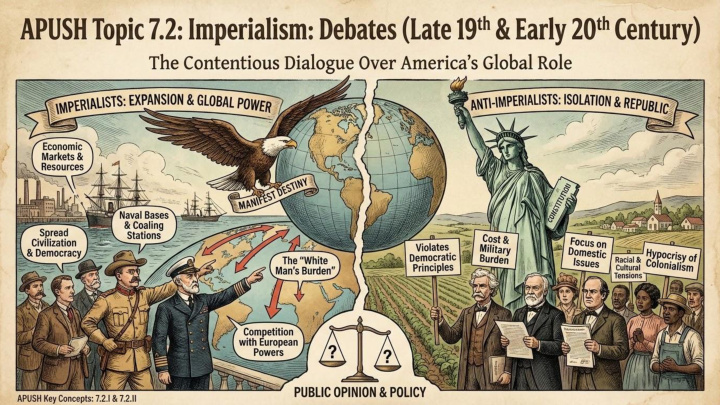
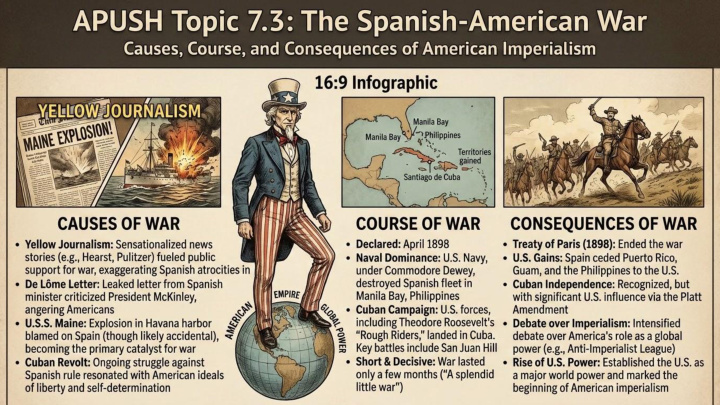
The Progressive Era produced landmark reforms — food safety laws, antitrust enforcement, workers' compensation, women's suffrage, and direct democracy. But Progressivism had limits: it was largely a movement of white middle-class reformers that often ignored or actively harmed Black Americans.
ProgressivismReformLimitations
Big Idea 2
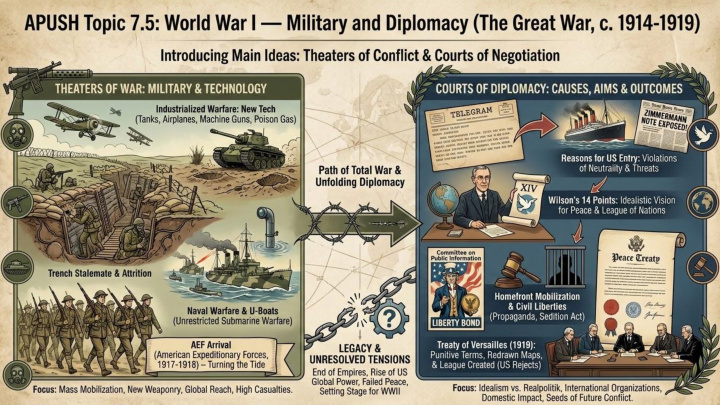
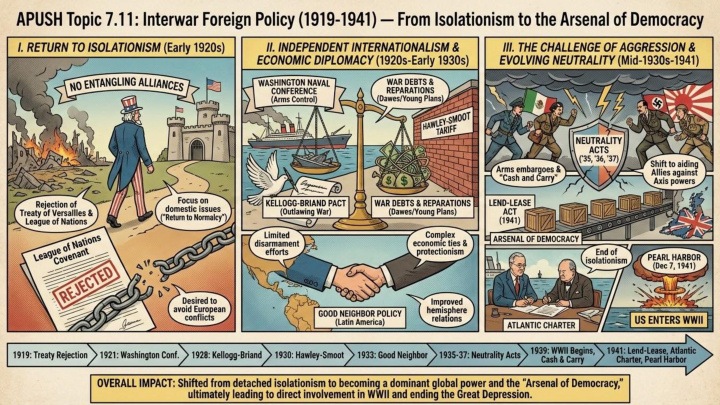
WWI transformed America's role in the world — and its politics at home
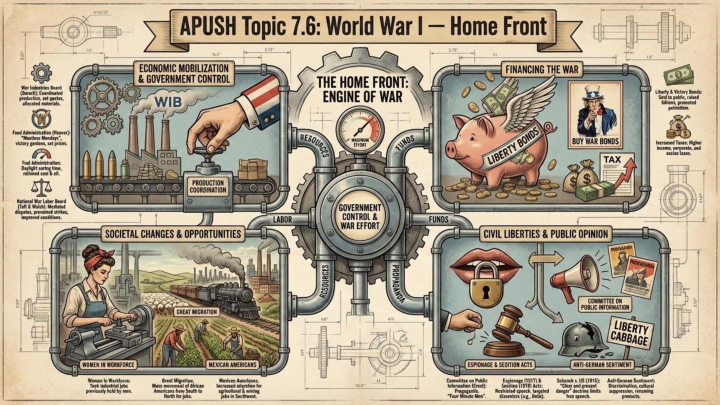
WWI pulled the US into global affairs permanently, despite Wilson's idealism and the Senate's rejection of the League. At home, wartime mobilization expanded federal power, suppressed dissent (Espionage Act), and accelerated the Great Migration.
WWIForeign PolicyHome Front
Big Idea 3
The New Deal transformed the relationship between Americans and their government
FDR's New Deal established the principle that the federal government is responsible for Americans' economic security. Social Security, bank regulation, and federal work programs changed expectations of government forever — creating what historians call the "liberal consensus" that lasted until the 1970s.
New DealFederal PowerLegacy
1 / 16
Question 1 of 5Score: 0/5
8
Unit 8
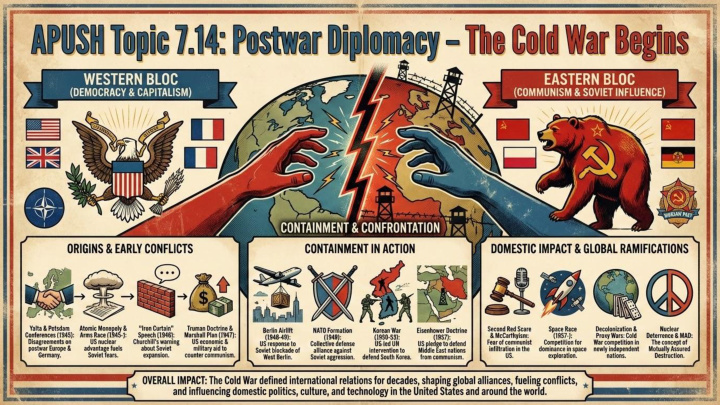
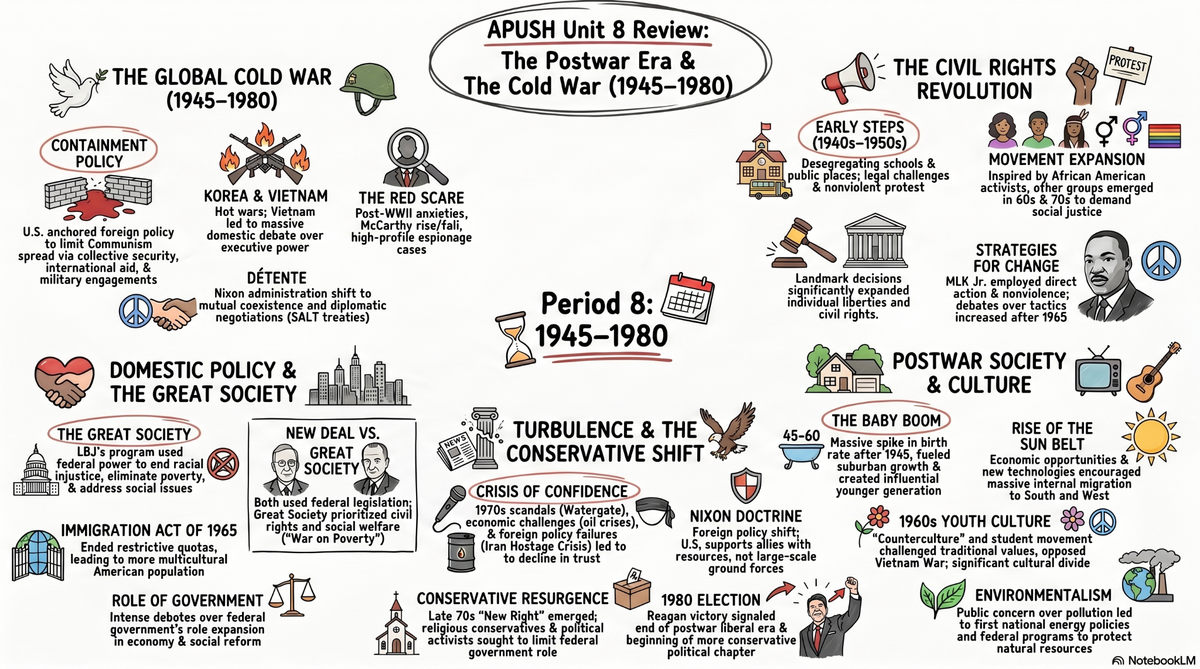
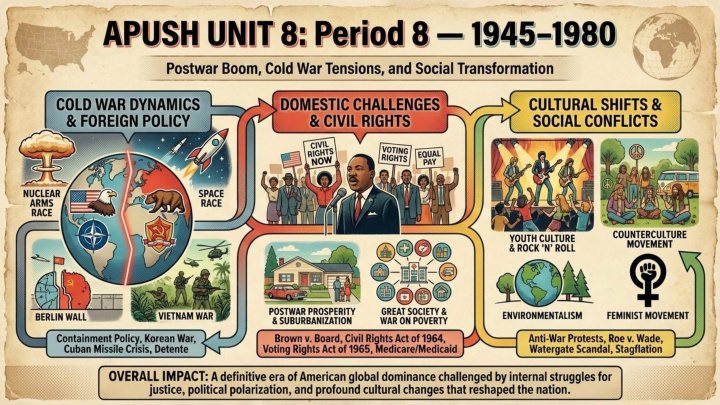
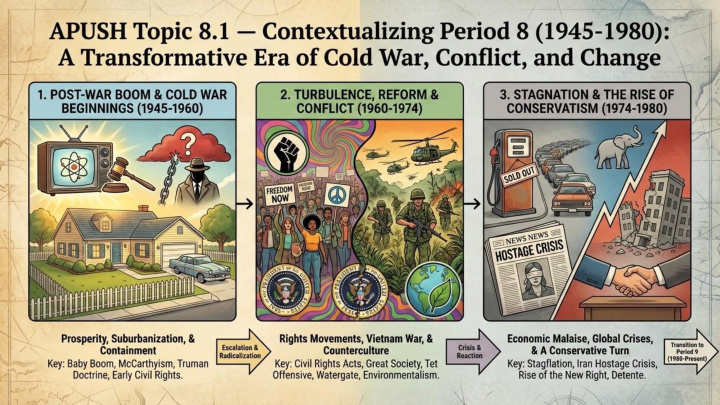
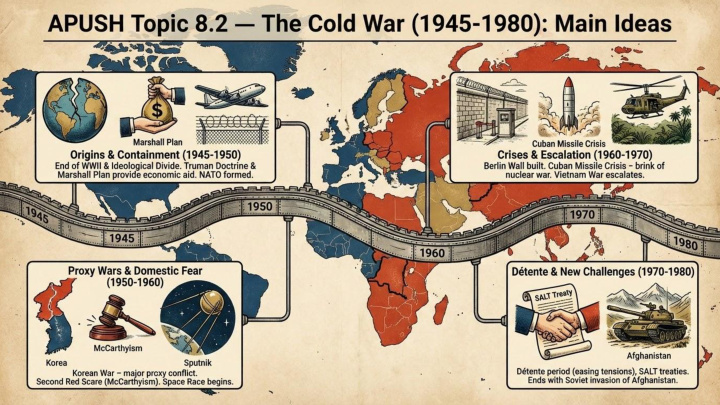
Period 8: The Cold War & Civil Rights (1945–1980)
1945–1980 · approx. 10–17% of exam
🎙
Unit 8: Period 8: The Cold War & Civil Rights (1945–1980)
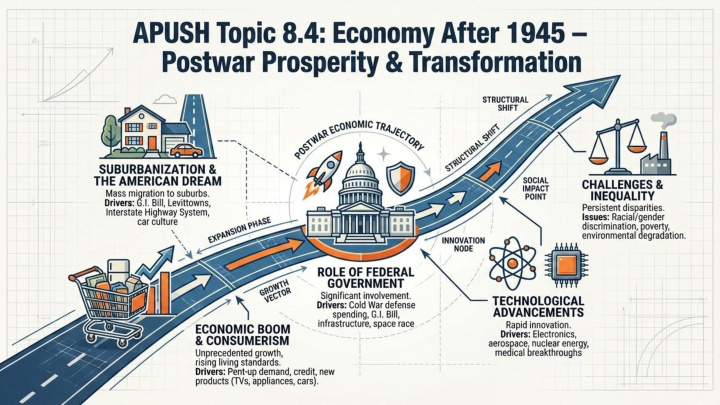
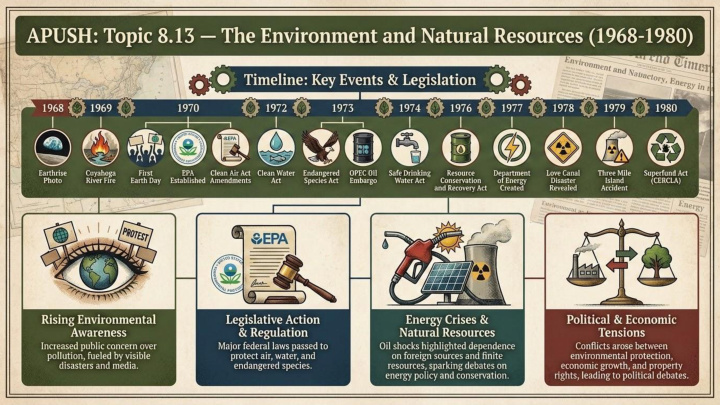
The Cold War, postwar prosperity, the civil rights movement, Vietnam, and the political upheaval of the 1960s-70s.
🎙 Episode 8 · --:--
0:00--:--
Question
What was the Truman Doctrine?
Unit 8 · Period 8
tap to flip
Answer
President Truman's 1947 policy committing the US to containing communism by supporting nations threatened by Soviet expansion — beginning the Cold War as a US policy framework.
Card 1 of 8
🔍
Containment
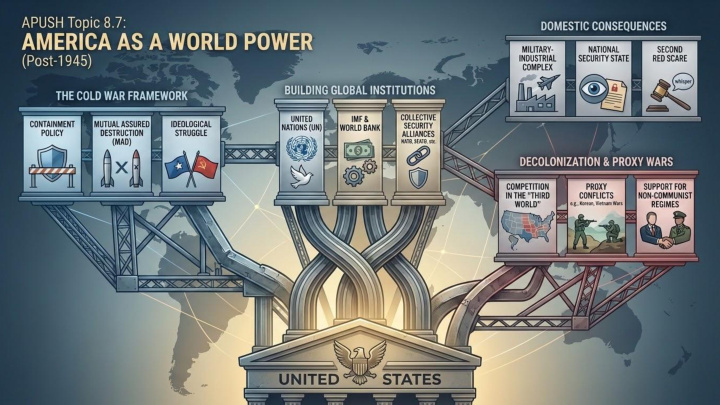
US Cold War strategy of preventing the further spread of Soviet communism beyond existing borders.
Cold War
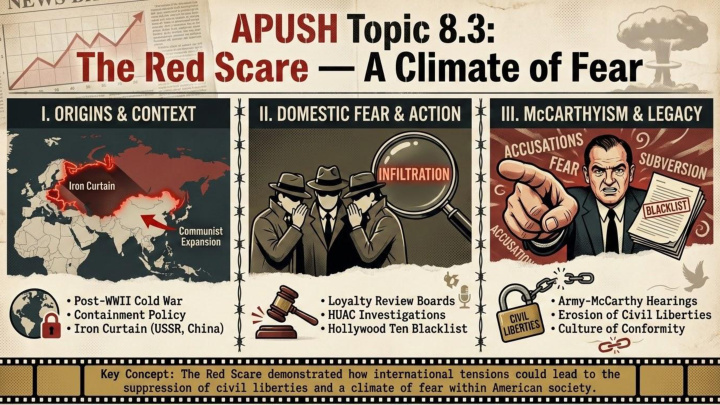
McCarthyism
Senator McCarthy's anti-Communist witch hunts (1950-54) creating fear and blacklisting.
Cold War
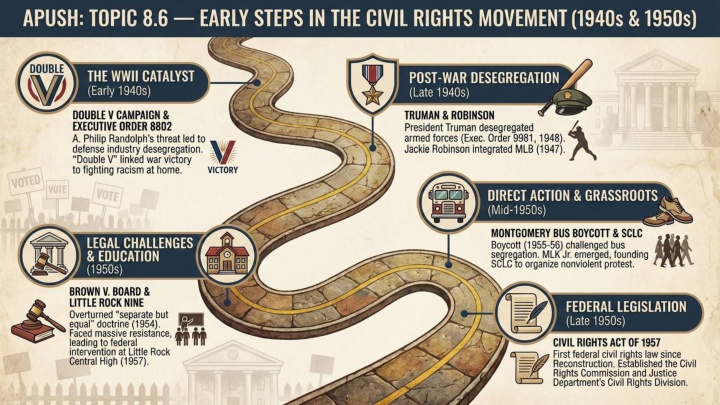
Brown v. Board (1954)
Supreme Court ruling declaring racial segregation in public schools unconstitutional.
Civil Rights
Civil Rights Act of 1964
Banned discrimination in employment and public accommodations based on race, color, religion, sex, or national origin.
Civil Rights
Voting Rights Act of 1965
Banned discriminatory voting practices that had disenfranchised Black voters in the South.
Civil Rights
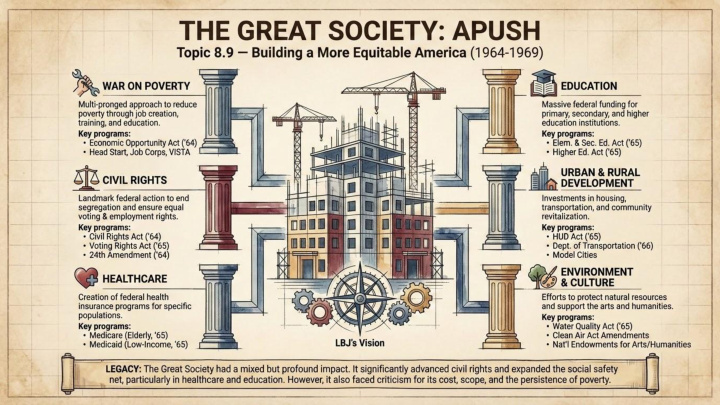
Great Society
LBJ's domestic programs creating Medicare, Medicaid, education funding, and civil rights legislation.
Domestic Policy
Détente
Nixon's policy of relaxing Cold War tensions through diplomacy with USSR and China.
Cold War
Watergate
Nixon's 1972 political espionage scandal that led to his resignation — deepening distrust of government.
Political Crisis
Big Idea 1
The Cold War shaped every aspect of American life, 1945–1991
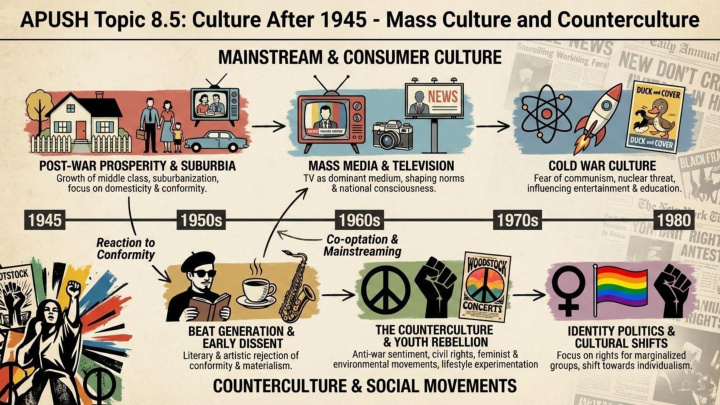
The Cold War wasn't just foreign policy — it shaped domestic politics (McCarthyism, civil defense), the economy (military-industrial complex), culture (conformity and rebellion), and civil rights (the contradiction of fighting for democracy abroad while practicing segregation at home).
Cold WarDomestic ImpactContradiction
Big Idea 2
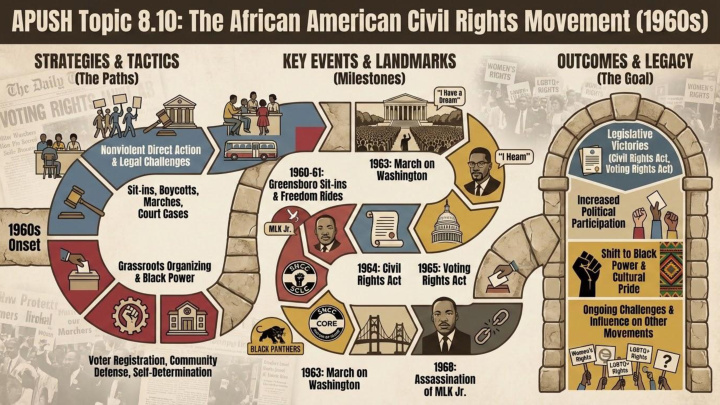
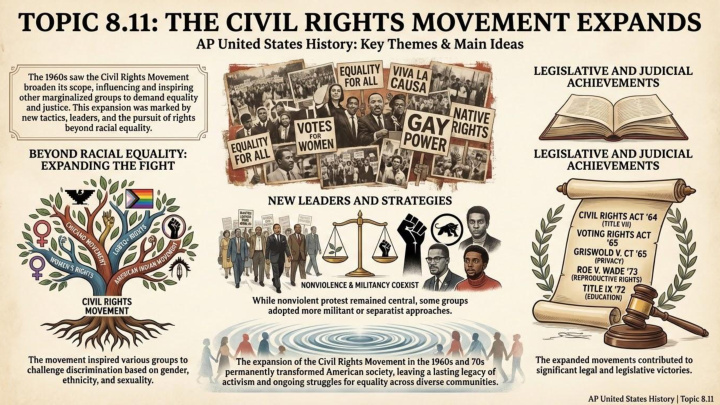
The Civil Rights Movement transformed America — through courage, strategy, and sacrifice
The movement used legal challenges (NAACP), nonviolent direct action (SCLC/SNCC), and political pressure to dismantle legal segregation. But it revealed the limits of legal reform: the Civil Rights Act didn't end economic inequality or housing discrimination.
Civil RightsStrategyLimitations
Big Idea 3
The 1960s shattered the postwar consensus — with lasting consequences
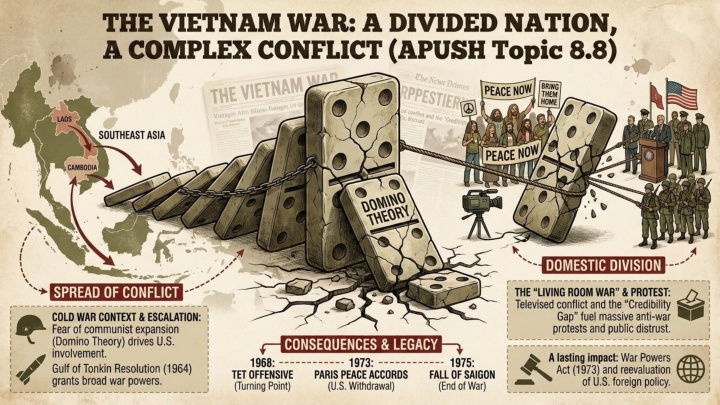
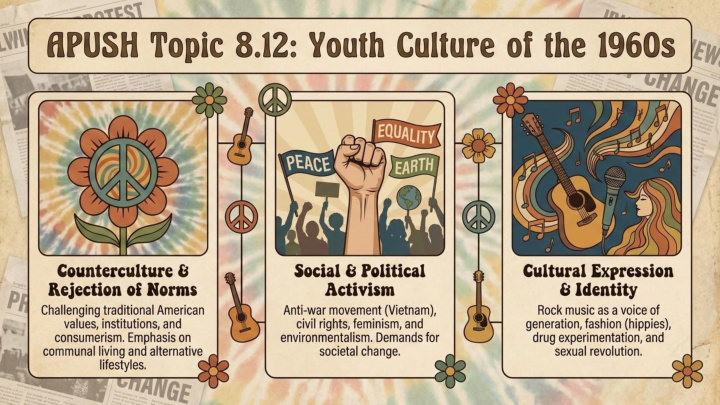
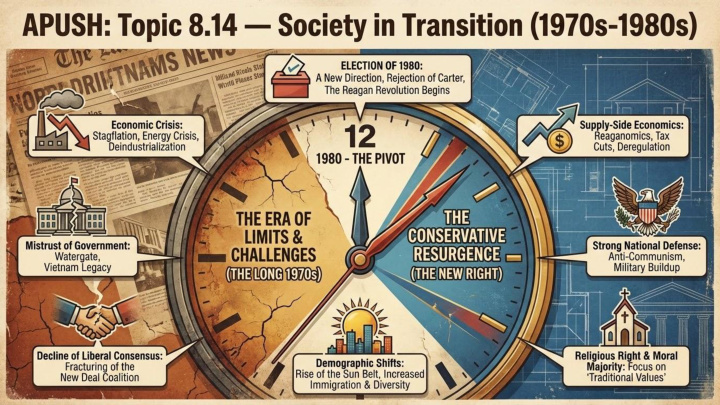
Vietnam, assassinations, urban unrest, and cultural revolution destroyed the liberal consensus of the New Deal era. The white backlash against civil rights and counterculture created the "silent majority" Nixon appealed to — reshaping the Republican Party and American politics for decades.
1960sBacklashPolitical Realignment
1 / 15
Question 1 of 5Score: 0/5
9
Unit 9
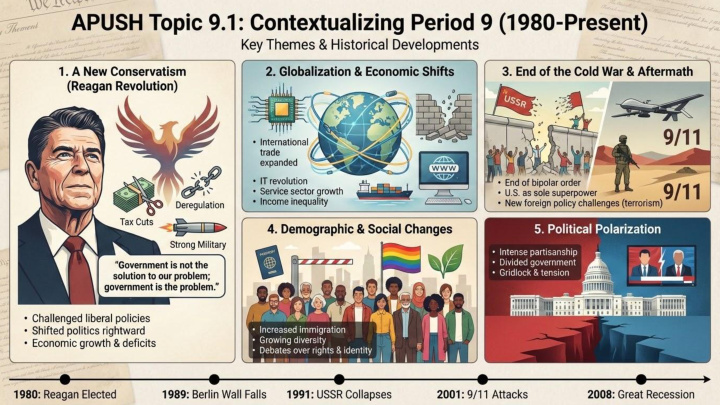
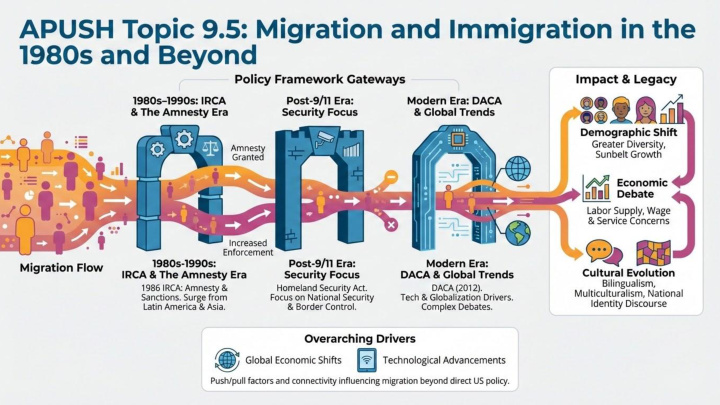
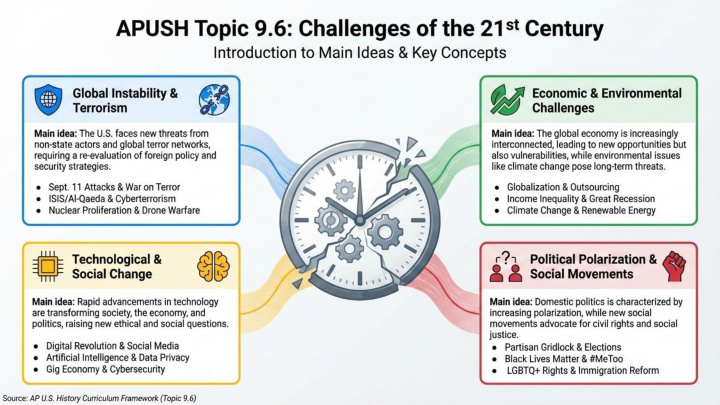
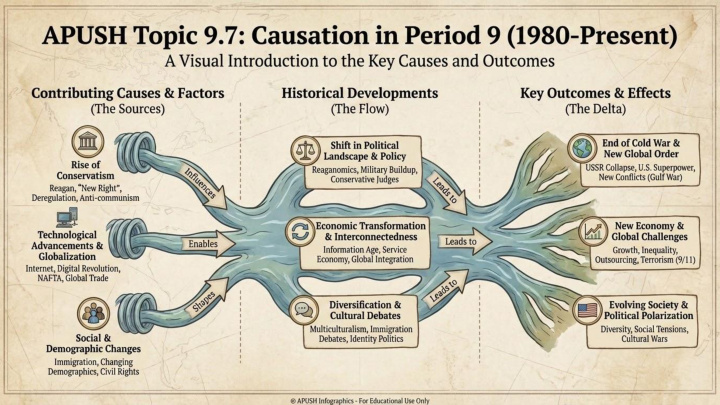
Period 9: The Conservative Revolution & Contemporary America (1980–Present)
1980–Present · approx. 4–6% of exam
🎙
Unit 9: Period 9: The Conservative Revolution & Contemporary America (1980–Present)
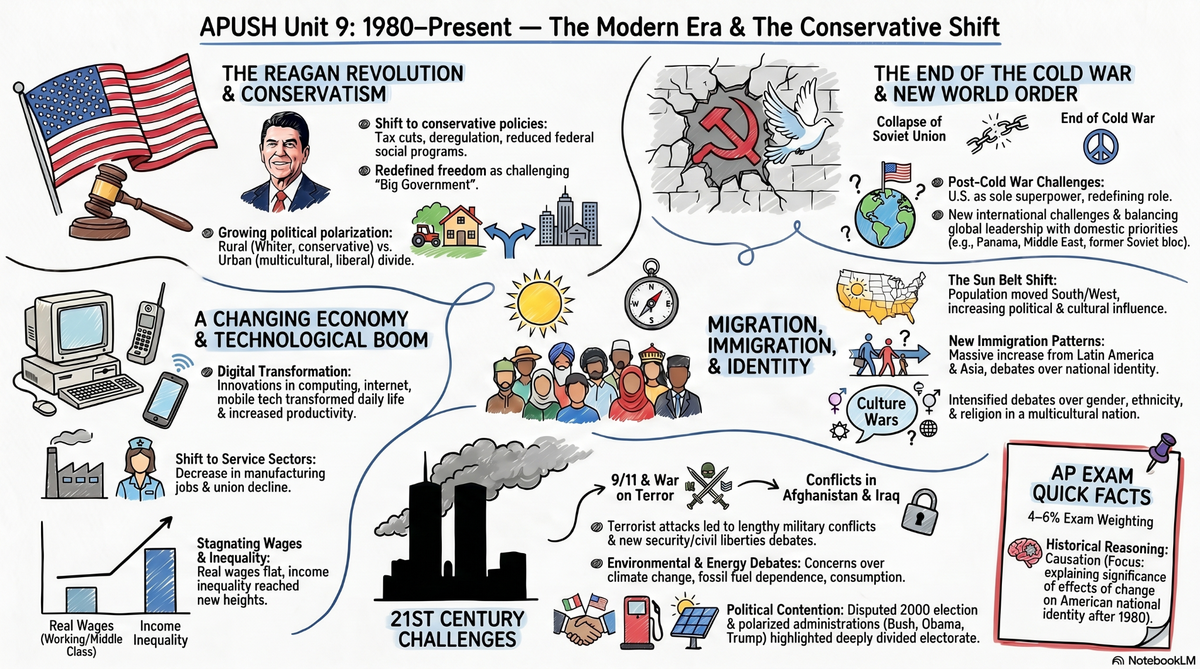
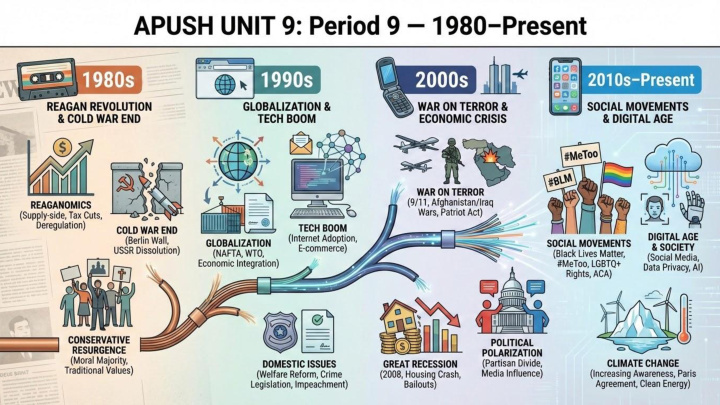
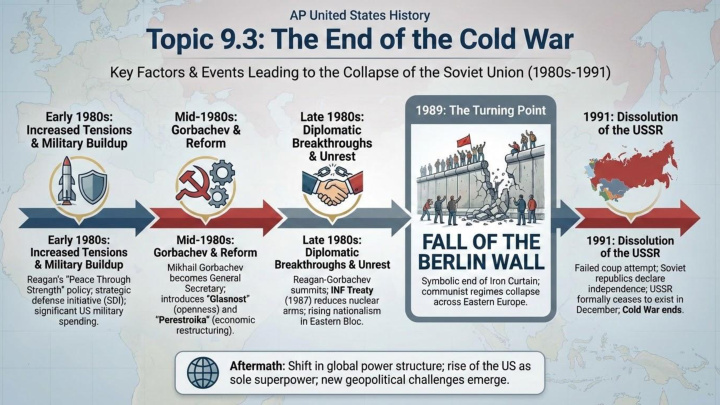
Reagan's conservative revolution, the end of the Cold War, globalization, 9/11, and contemporary political polarization.
🎙 Episode 9 · --:--
0:00--:--
Question
What was "Reaganomics"?
Unit 9 · Period 9
tap to flip
Answer
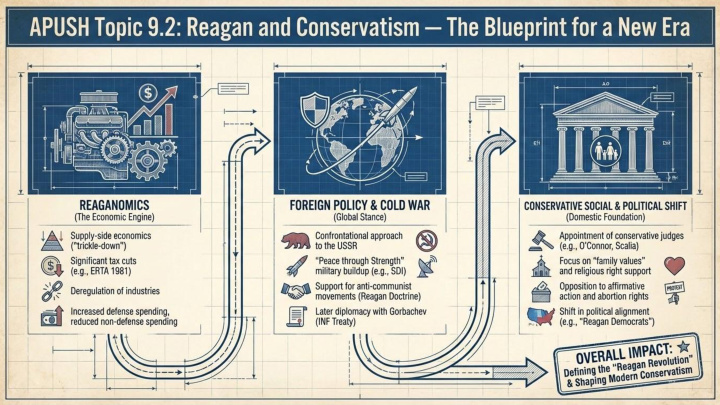
Reagan's economic policy (supply-side economics) of cutting taxes for the wealthy, reducing domestic spending, deregulating business, and increasing defense spending — based on "trickle-down" theory that wealth at the top benefits all.
Card 1 of 8
🔍
Supply-Side Economics
Theory that cutting taxes on wealthy and businesses stimulates economic growth benefiting all — "trickle-down."
Economic Policy
Reagan Revolution
Conservative political transformation emphasizing tax cuts, deregulation, military buildup, and smaller government.
Political History
Contract with America
1994 Republican platform pledging welfare reform, balanced budget, and crime legislation — leading to Congress flip.
Political History
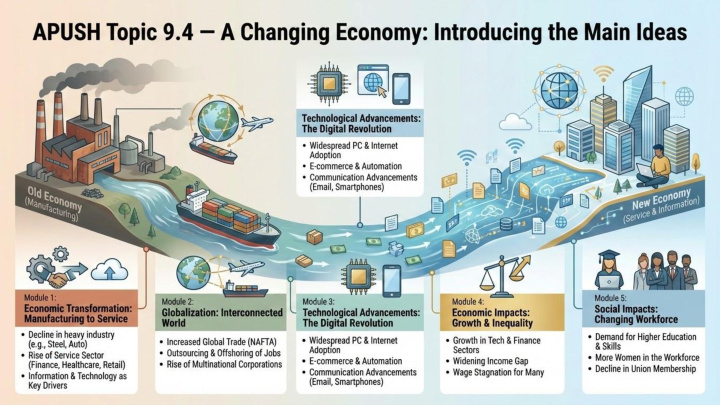
NAFTA
North American Free Trade Agreement (1994) eliminating tariffs between US, Canada, and Mexico.
Trade Policy
USA PATRIOT Act
2001 law expanding government surveillance powers following 9/11 attacks.
Civil Liberties
War on Terror
Post-9/11 US military and security campaign beginning with Afghanistan and Iraq invasions.
Foreign Policy
Affordable Care Act (2010)
Obama's health care reform expanding coverage through insurance markets and Medicaid expansion.
Domestic Policy
Political Polarization
Growing ideological gap between Democratic and Republican parties, with declining political compromise.
Contemporary Politics
Big Idea 1
The Reagan Revolution reshaped American politics for decades
Reagan's 1980 election marked a fundamental shift in American politics — away from New Deal liberalism toward conservatism. Tax cuts, deregulation, and anti-government rhetoric became Republican orthodoxy, shifting the entire political spectrum rightward. Even Bill Clinton declared "the era of big government is over."
ConservatismReaganPolitical Realignment
Big Idea 2
The end of the Cold War created new challenges rather than a "peace dividend"
The Soviet collapse left the US as the world's sole superpower — but 9/11 revealed the limits of that power. The wars in Afghanistan and Iraq proved that military dominance couldn't easily achieve political goals, and created the conditions for the instability and polarization that followed.
Cold War EndPost-9/11Foreign Policy
Big Idea 3
Contemporary polarization has deep historical roots
Today's political polarization isn't new — it reflects longstanding tensions over race, government's role, and economic inequality that run throughout American history. Understanding today's divisions requires understanding the backlash politics of the 1960s-70s, the Reagan Revolution, and the economic dislocations of globalization.